
Who Runs The National Lottery?

Who Runs The National Lottery? Every UK National Lottery Operator, What They Do, Why They Change and Who Could Run It Next
Ask “Who runs The National Lottery?” and, unlike the question of who owns it, there is a relatively straightforward answer.
The National Lottery is currently run by Allwyn Entertainment Ltd.
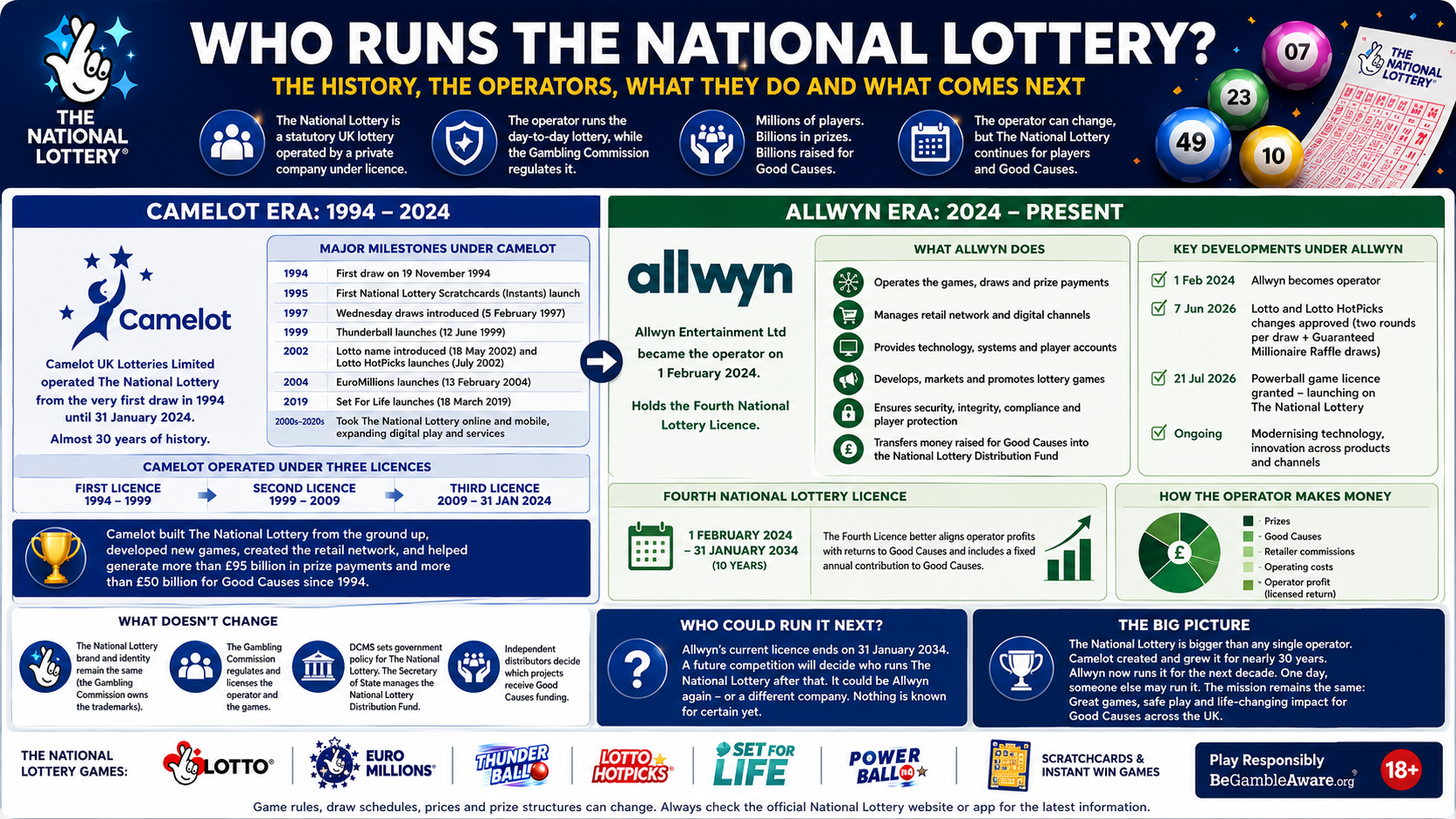
Allwyn became the official operator on 1 February 2024, replacing Camelot UK Lotteries Limited, which had operated The National Lottery from its beginning in 1994. Allwyn holds the Fourth National Lottery Licence, which currently runs until 31 January 2034.
But that simple answer opens the door to a much bigger story.
What exactly does it mean to “run” The National Lottery?
What does an operator actually do?
Does the operator decide what games we play?
Does it own the money?
Does it pay the jackpots?
Does it choose where Good Causes money goes?
How does the operator make a profit?
Why was Camelot allowed to run The National Lottery for almost 30 years?
Why did Camelot eventually lose it?
Why did Allwyn win?
Was Camelot a good operator?
Is Allwyn better?
Who could operate The National Lottery after 2034?
And perhaps most interestingly, if The National Lottery has existed since 1994, how many different companies have actually run it?
The answer to that last question is surprisingly simple.
Just two.
Camelot and Allwyn.
More than three decades of National Lottery history can therefore be divided into two great operating eras.
The Camelot era: 1994–2024.
And the Allwyn era: 2024–present.
Understanding those two operators explains a huge amount about how Britain’s National Lottery actually works.
What Is a National Lottery Operator?
The National Lottery operator is the commercial company granted the legal right and responsibility to run The National Lottery.
It does this under a licence.
The principal operating licence is known as the Section 5 Licence, referring to Section 5 of the National Lottery etc. Act 1993.
The Gambling Commission awards that licence.
Separate Section 6 licences cover individual games or classes of games forming part of The National Lottery.
This distinction is important.
The operator does not simply wake up one morning and announce:
“We are Britain’s National Lottery company.”
It must win the right to operate it.
It must satisfy extensive requirements.
It must operate within the legislation.
It must comply with its licence.
And it remains subject to Gambling Commission regulation.
The operator is therefore effectively the commercial engine behind The National Lottery.
What Does the National Lottery Operator Actually Do?
Almost everything a player experiences requires an operator behind it.
Someone has to create and maintain the infrastructure through which tickets are sold.
Someone has to operate the website and digital channels.
Someone has to support thousands of retailers.
Someone has to process transactions.
Someone has to administer games.
Someone has to manage prize claims.
Someone has to maintain technology.
Someone has to market the products.
Someone has to manage security.
Someone has to protect player accounts and information.
Someone has to communicate winning numbers and results.
Someone has to administer scratchcards and digital Instant Win Games.
Someone has to work with suppliers.
Someone has to transfer the required proceeds into the Good Causes funding system.
And someone has to make sure that an enormous lottery system involving billions of pounds continues functioning day after day.
That is fundamentally the operator’s job.
Running The National Lottery Is an Enormous Undertaking
It is easy to think about The National Lottery purely from the player’s perspective.
You buy a £2 Lotto ticket.
You enter EuroMillions.
You buy a scratchcard.
You check the results.
Behind that apparently simple transaction is a huge technological, financial, retail and regulatory operation.
The National Lottery is one of the world’s largest lotteries. Since 1994 it has paid more than £95 billion in prize money and generated more than £50 billion for Good Causes.
The operator therefore isn’t merely running a website or producing a televised ball draw.
It is administering a national-scale financial and gaming infrastructure.
Does the Operator Own The National Lottery?
No.
This is the distinction explored in our separate E-Lotto.co.uk guide to who owns The National Lottery.
The operator runs The National Lottery under licence.
That licence has an expiry date.
Camelot once held it.
Camelot lost it.
Allwyn now holds it.
Allwyn’s current licence expires in 2034.
The operator can therefore change while The National Lottery continues.
Who Was the First National Lottery Operator?
The first operator was Camelot.
Camelot was selected to operate the newly created National Lottery in 1994.
The first National Lottery draw took place on Saturday 19 November 1994.
That began an extraordinary period.
Camelot would continue operating The National Lottery for almost 30 years.
For millions of British players, Camelot effectively became synonymous with The National Lottery.
Camelot: 1994–2024
Camelot’s importance to National Lottery history is difficult to overstate.
It was the operator that turned a piece of legislation into an enormous consumer institution.
When the first National Lottery draw took place, there was no EuroMillions.
There was no Thunderball.
There was no Set For Life.
There was no Lotto HotPicks.
There was no National Lottery smartphone app.
There were no modern online accounts.
There were not even National Lottery scratchcards yet.
Camelot was there from the beginning.
The First Camelot Era
The original National Lottery was fundamentally a Saturday-night lottery.
Players bought physical tickets through retailers.
The draw was televised.
Millions watched.
The famous crossed-fingers National Lottery branding became embedded in British popular culture.
Camelot had to establish the retailer network, game infrastructure, prize system, marketing and enormous operational machinery required to turn The National Lottery into a functioning national business.
The early results were remarkable.
The National Lottery rapidly became one of the most recognisable brands in Britain.
Camelot Introduces Scratchcards
The first National Lottery scratchcards arrived in March 1995.
That represented an important expansion of the operator’s role.
Camelot was no longer administering only a weekly draw game.
It was now operating an instant-win lottery product too.
The National Lottery was beginning its transition from a single game into a portfolio.
The Wednesday Draw Arrives
In February 1997, the Wednesday National Lottery draw was introduced.
Again, the operator had to accommodate an expanding lottery.
Instead of the flagship game existing purely as a Saturday event, it now operated twice each week.
The familiar Wednesday-and-Saturday structure had begun.
Camelot Launches Thunderball
Thunderball followed in 1999.
This was important because Thunderball was not simply another occurrence of the original draw.
It was a separate National Lottery game.
Camelot was therefore increasingly becoming a multi-product lottery operator.
That distinction would become even more important during the following decade.
Lotto and HotPicks
In 2002, the original flagship National Lottery draw became known as Lotto.
Lotto HotPicks was also introduced.
The distinction between The National Lottery and its individual games was becoming increasingly obvious.
The National Lottery was the umbrella.
Lotto was a game beneath that umbrella.
Thunderball was another.
HotPicks was another.
Scratchcards were another product category.
The operator was responsible for making the entire ecosystem work.
Camelot Takes The National Lottery Online
One of Camelot’s most important achievements was guiding The National Lottery through the internet revolution.
The lottery launched in 1994, when internet use among ordinary British households was still in its infancy.
The original system was overwhelmingly physical.
By the 2000s, that world was changing rapidly.
The National Lottery began offering interactive products online.
Players could establish online accounts.
Tickets could increasingly be purchased digitally.
Results could be checked online.
The National Lottery began its transformation from a physical retail lottery into an omnichannel operation.
That transformation happened under Camelot.
EuroMillions Arrives
Then came EuroMillions.
The first EuroMillions draw took place in February 2004.
For Camelot, this represented another major operational change.
The National Lottery was no longer administering only domestic games.
UK players were participating in a shared multinational European lottery.
EuroMillions would eventually produce jackpots worth more than £100 million and, in the case of the biggest UK jackpot, approximately £195 million.
Operating a lottery capable of producing prizes on that scale requires enormous financial and administrative reliability.
Camelot Survives Multiple Licence Competitions
Camelot did not receive a permanent right to run The National Lottery in 1994.
It had to continue securing operating licences.
Camelot successfully operated under the First National Lottery Licence.
It then secured the Second Licence.
It subsequently secured the Third Licence.
The Third Licence began in 2009 and was initially a ten-year licence. It was extended by four years in 2012, then by six months in March 2021 and another six months in December 2021, eventually expiring on 31 January 2024.
That sequence helps explain why Camelot remained operator for so long.
It didn’t receive one 30-year licence.
It repeatedly retained the right to operate The National Lottery.
The Third Licence Era
The Third National Lottery Licence became the final Camelot licence.
This period encompassed another substantial phase of digital growth.
Smartphones became ubiquitous.
Mobile internet became normal.
Consumer behaviour shifted towards apps and online accounts.
The National Lottery increasingly had to operate across retail and digital channels simultaneously.
Set For Life was introduced in 2019.
EuroMillions continued growing.
Scratchcards and Interactive Instant Win Games remained major products.
Camelot had successfully taken The National Lottery from the analogue world of 1994 into the smartphone era.
Was Camelot a Good National Lottery Operator?
This is where the question becomes subjective.
There is no scientifically objective league table that allows us to say:
Camelot = 8.7/10.
Any serious assessment needs to acknowledge both achievements and criticisms.
Camelot’s strongest argument is longevity combined with scale.
It successfully launched The National Lottery.
It operated it for almost three decades.
The system produced enormous prize payments.
It generated tens of billions of pounds for Good Causes.
It survived huge technological changes.
It expanded from one principal draw into a multi-product operation.
It took The National Lottery online.
It introduced or operated major products including Thunderball, EuroMillions and Set For Life.
And it maintained an institution that became deeply embedded in British culture.
Those are substantial achievements.
The Case Against Camelot
Longevity does not mean Camelot escaped criticism.
One of the recurring questions around National Lottery operation has been whether enough money from ticket sales was reaching Good Causes.
The balance between sales, prizes, operator incentives and Good Causes became increasingly important.
There were also questions over whether the existing operating model was sufficiently innovative for a rapidly changing digital marketplace.
By the time the Fourth Licence competition arrived, the Gambling Commission was explicitly looking towards a different regulatory model with stronger alignment between the operator’s profits and returns to Good Causes.
That tells us something important.
The regulator did not merely want a new company.
It wanted to change aspects of how the operator was incentivised.
The Fourth National Lottery Licence Competition
The competition for the Fourth National Lottery Licence was launched in August 2020.
This was a major event.
For the first time in decades, there was a genuine possibility that Camelot might no longer operate The National Lottery.
The prize was enormous.
The winner would receive the right and responsibility to run Britain’s National Lottery for the next licence period.
Camelot wanted to retain it.
Other bidders wanted to take it away.
Allwyn Wins
On 15 March 2022, the Gambling Commission announced Allwyn as its preferred applicant for the Fourth National Lottery Licence.
The licence was formally awarded to Allwyn on 20 September 2022 following legal proceedings surrounding the competition.
The transition could begin.
Camelot was now the outgoing operator.
Allwyn was the incoming operator.
For the first time in National Lottery history, the enormous machinery behind the lottery had to be transferred from one licensee to another.
Why Did Allwyn Win?
The Gambling Commission assessed bids against the requirements and evaluation framework of the Fourth Licence competition rather than simply deciding that one company “looked better.”
The regulatory objectives surrounding The National Lottery are fundamental.
The Commission’s duties include ensuring that The National Lottery is run with due propriety, that participants’ interests are protected and, subject to those requirements, that returns to Good Causes are maximised.
Allwyn’s successful proposal included substantial commitments relating to investment, growth and innovation across National Lottery products and channels, with the expectation of increasing contributions to Good Causes while protecting participants.
So this wasn’t simply:
“Who can sell the most tickets?”
It was about the overall operation.
1 February 2024: The Camelot Era Ends
The date 1 February 2024 deserves a significant place in National Lottery history.
At midnight, an era that had effectively existed since the birth of The National Lottery ended.
Camelot’s Third Licence expired on 31 January.
Allwyn’s Fourth Licence began on 1 February.
The Gambling Commission described it as the first ever change of licensee in the history of The National Lottery.
For almost 30 years:
Camelot = National Lottery operator.
Then suddenly:
Allwyn = National Lottery operator.
Did Players Notice the Change?
For the average player, continuity was essential.
Imagine the disruption if millions of tickets suddenly became invalid or National Lottery retailers stopped operating because a corporate licence had changed.
That could not happen.
The transition therefore had to preserve the operation of The National Lottery while transferring responsibility from one licensee to another.
The Gambling Commission, Camelot, Allwyn and government all had roles in ensuring continuity.
The National Lottery kept running.
That is an impressive operational undertaking in itself.
Allwyn: 2024–Present
Allwyn is now responsible for operating The National Lottery.
Its current licence lasts ten years, from 1 February 2024 until 31 January 2034.
This is the Fourth National Lottery Licence.
Allwyn therefore inherited an institution approaching its 30th anniversary.
But it did not simply inherit the same regulatory framework Camelot had operated under.
The Fourth Licence introduced significant changes.
What Is Different About the Fourth Licence?
One of the biggest differences is the relationship between operator profit and Good Causes.
The Gambling Commission describes the Fourth Licence as designed to better align Returns to Good Causes and profits.
Under the new incentive mechanism, profits made from operating The National Lottery are shared between the licensee and Good Causes, and the operator must also make a fixed contribution to Good Causes for each licence year.
That is an important structural development.
It attempts to make the operator’s commercial success and Good Causes returns pull more strongly in the same direction.
What Does Allwyn Have to Provide?
Allwyn has to provide far more than lottery balls and tickets.
It must provide the operational capability required to run the entire National Lottery ecosystem.
That includes the technology supporting games and transactions.
It includes the retail infrastructure through which physical tickets and scratchcards are sold.
It includes online and digital channels.
It includes player-facing services.
It includes prize administration.
It includes systems for regulatory reporting and assurance.
It includes protections for participants.
It includes the commercial development and promotion of National Lottery products.
And it must do all of this while satisfying the conditions of its operating and game licences.
Can Allwyn Change Lotto Whenever It Wants?
No.
This is an important limitation on what “operator” means.
The Gambling Commission grants licences for National Lottery games and classes of games.
These currently include Lotto, EuroMillions, Thunderball, Powerball, Lotto HotPicks, EuroMillions HotPicks, Set For Life, scratchcards and Interactive Instant Win Games.
When Allwyn wants to make changes to these games, it must apply to the Gambling Commission for approval.
So the operator has considerable commercial freedom, but not unlimited freedom.
Allwyn and the 2026 Lotto Changes
A good example came in 2026.
The Gambling Commission approved variations to the Lotto and Lotto HotPicks licences taking effect from 7 June 2026, including two rounds per Wednesday and Saturday draw, special Guaranteed Millionaire Raffle event draws and related changes to the prize structure.
Allwyn could develop the proposition.
But regulatory approval was required.
That demonstrates the operator-regulator relationship in practice.
Allwyn and Powerball
Another major example arrived in July 2026.
The Gambling Commission granted Allwyn a new Section 6 Licence allowing it to introduce the US draw-based Powerball game to the UK National Lottery portfolio, effective 21 July 2026.
This is historically significant.
It illustrates exactly what an operator can do when innovation, licensing and regulatory approval come together.
The National Lottery portfolio can evolve.
But the operator does not have unilateral authority to introduce anything it wishes.
Does the Operator Decide Where Good Causes Money Goes?
No.
This is another common misconception.
The operator helps generate and transfer the money that ultimately supports Good Causes.
It does not simply maintain a pot of money and decide:
“This community centre gets £500,000.”
“This museum gets £2 million.”
“This sports club gets £50,000.”
Distribution is handled through the separate National Lottery Good Causes funding structure.
The commercial operator and the organisations making grant decisions are therefore distinct.
Does the Operator Pay Winners?
Operationally, the National Lottery operator is responsible for the systems through which prizes are validated, administered and paid according to the rules of the relevant game.
This is a crucial responsibility.
For small prizes, the process can appear almost trivial.
For enormous jackpots, it becomes considerably more significant.
EuroMillions has produced UK jackpots approaching £200 million.
The integrity of the validation and prize-payment infrastructure therefore matters enormously.
Does the Operator Make a Profit?
Yes.
The National Lottery operator is a commercial company.
It is not running The National Lottery as a charity.
The question is how that commercial incentive interacts with the public-purpose objectives of the lottery.
Under the Fourth Licence, the Gambling Commission deliberately changed the incentive structure to align the operator’s interests more closely with contributions to Good Causes.
The basic principle is important:
commercial success is permitted, but it exists inside a heavily regulated structure.
Is Allwyn Better Than Camelot?
It is too early to give a definitive historical verdict.
Camelot operated The National Lottery for nearly three decades.
Allwyn has operated it for only a fraction of that period.
Comparing them directly would therefore be unfair without acknowledging the enormous difference in time.
Camelot’s achievements can be judged across approximately 30 years.
Allwyn’s complete legacy cannot be assessed until much later.
Has Allwyn’s Transition Been Perfect?
No.
This is important if E-Lotto.co.uk wants to provide a balanced historical account rather than simply repeat corporate marketing.
The Gambling Commission’s 2024/25 annual report stated that there had been delays in Allwyn achieving full implementation of commitments that had been agreed for delivery by February 2025.
The Commission said it had initiated enforcement action in response.
So while Allwyn’s bid promised investment, modernisation and innovation, implementation has not been entirely trouble-free.
That needs to form part of any fair assessment.
Is Allwyn a Bad Operator?
It would be equally premature to say that.
The Fourth Licence is only in its early years.
Allwyn inherited an enormous legacy operation and is undertaking a substantial modernisation programme.
The Gambling Commission continues to regulate the operator, monitor its performance and oversee implementation.
There have also been significant product developments.
Lotto changes have been approved.
Powerball has received a UK National Lottery game licence.
The regulatory and commercial architecture is evolving.
The meaningful question is not whether every implementation milestone has gone perfectly.
It is whether the Fourth Licence ultimately produces a safer, more modern National Lottery that generates stronger sustainable returns for Good Causes.
That judgment requires more time.
Who Was the Best National Lottery Operator?
There have only been two, and one is still relatively new.
So declaring a definitive winner would be artificial.
Camelot currently has the stronger historical record simply because it built and operated The National Lottery successfully for almost three decades.
It launched the lottery.
It developed the retail network.
It oversaw enormous growth.
It introduced and operated new games.
It took The National Lottery online.
It helped make EuroMillions a major UK product.
It navigated the transition from television-centric lottery participation to internet and mobile play.
And during the broader lifetime of The National Lottery, tens of billions of pounds were generated for Good Causes.
Allwyn has not yet had enough time to produce an equivalent multi-decade record.
That does not mean Camelot will necessarily remain the “best.”
It means the comparison is not yet like-for-like.
Who Was the Worst National Lottery Operator?
This question has an even bigger problem.
There have only been two operators.
Camelot had successes and criticisms.
Allwyn has ambitious commitments and has already faced implementation delays.
Calling either the “worst” would imply a meaningful field of alternatives and a completed historical record that simply does not exist.
A more useful comparison is:
Which operator performed best against the objectives of its particular licence?
That can be assessed using areas such as player protection, operational reliability, innovation, sales, returns to Good Causes, digital development, retailer performance and compliance.
On that basis, Camelot has a complete historical record.
Allwyn’s remains in progress.
Why Was Camelot Replaced If It Was Successful?
Because operating The National Lottery is not a lifetime appointment.
Success under previous licences does not guarantee the next one.
The purpose of a competitive licence process is precisely to allow alternative operators to demonstrate that they can offer a stronger proposition for the next era.
Camelot’s 28 years of operation did not entitle it automatically to another decade.
Allwyn submitted the successful proposal for the Fourth Licence.
That is how the model is supposed to work.
Why Change Operators at All?
Competition can force potential operators to propose investment and innovation.
If one company automatically retained The National Lottery forever, there would be less competitive pressure at licence renewal.
A licensing competition allows the regulator to ask:
Who can protect players?
Who can operate with due propriety?
Who can modernise the lottery?
Who can deliver reliable technology?
Who can grow participation appropriately?
Who can generate the strongest sustainable returns for Good Causes?
And who can do all of those things together?
The licence can then be awarded based on the applicable competition framework.
Why Are National Lottery Licences So Long?
Running The National Lottery requires huge investment.
An operator needs technology.
Infrastructure.
Retail systems.
People.
Marketing.
Security.
Digital services.
Supplier contracts.
Game development.
Compliance systems.
A company would be unlikely to make enormous long-term investments if it held the licence for only a very short period.
A multi-year licence gives the operator time to invest and implement its strategy.
But an expiry date preserves the possibility of future competition.
It attempts to balance stability with accountability.
Could the Operator Lose the Licence Early?
Potentially, regulatory enforcement can be serious.
The Gambling Commission has oversight powers, and government documentation notes that its regulatory options can ultimately extend to revocation of the operating licence where appropriate.
That would obviously be an extreme outcome.
But it illustrates that the operator’s right to run The National Lottery is conditional rather than absolute.
Who Regulates the Operator?
The Gambling Commission.
Its National Lottery responsibilities are distinct from merely supervising ordinary commercial gambling.
The Commission’s statutory objectives include ensuring that The National Lottery is run with due propriety, protecting participants’ interests and, subject to those objectives, maximising returns to Good Causes.
The operator therefore answers to a regulator with very specific statutory duties.
Who Regulated Camelot Before the Gambling Commission?
The regulatory structure itself has evolved over the history of The National Lottery.
The original regulatory body was the Office of the National Lottery, commonly known as OFLOT.
Later, the National Lottery Commission took over regulatory responsibilities.
In 2013, National Lottery regulation transferred to the Gambling Commission.
So even while Camelot remained the operator, the organisation regulating it changed.
That is another reminder that National Lottery history involves several different layers:
the lottery,
the operator,
the regulator,
government,
and the Good Causes distribution system.
They should not be confused.
How Many National Lottery Operators Have There Been?
Only two.
Camelot UK Lotteries Limited — 1994 to 31 January 2024.
Allwyn Entertainment Ltd — 1 February 2024 to the present.
That is an extraordinary degree of continuity for an institution more than 30 years old.
How Many National Lottery Licences Have There Been?
There have been four principal operating licence periods.
Camelot operated under the first three.
Allwyn operates under the fourth.
This means the history is not:
Camelot licence → Allwyn licence.
It is more accurately:
First Licence — Camelot
Second Licence — Camelot
Third Licence — Camelot
Fourth Licence — Allwyn
That distinction explains how Camelot could remain operator for almost three decades without permanently owning The National Lottery.
Who Will Run The National Lottery Next?
Nobody currently knows.
Allwyn’s licence runs until 31 January 2034.
There is therefore no confirmed “next operator” at present.
It might be Allwyn again.
It might eventually be another company.
The framework for what follows the Fourth Licence will determine the answer.
Any article claiming today to know definitively who will operate The National Lottery after 2034 would be speculating.
Could Allwyn Run It Beyond 2034?
Yes, potentially.
Just as Camelot successfully retained The National Lottery across multiple licences, Allwyn could potentially compete to remain operator under whatever future arrangements apply.
Nothing about the current ten-year licence automatically means Allwyn must disappear in 2034.
But nothing gives it an automatic permanent right to remain either.
That uncertainty is deliberate.
Could Camelot Come Back?
This question is more complicated than it sounds because Allwyn’s wider group acquired Camelot UK during the transition period.
So talking about “Camelot returning” as though it remained the same independent rival to Allwyn is misleading.
The more relevant question is whether a different corporate bidder could eventually replace Allwyn.
The answer is potentially yes, depending upon the future licensing framework.
Who Could Bid Next?
It is far too early to produce a reliable list of future bidders.
The next licence arrangements have not reached the stage where we can confidently identify a field and say:
“These are the companies competing to run The National Lottery after 2034.”
The Fourth Licence competition attracted significant commercial interest and legal challenges.
A future competition would likely attract serious lottery and gaming businesses if its structure permits them to participate.
But until a future process is established, specific predictions should be treated as speculation rather than fact.
What Makes a Good National Lottery Operator?
A good operator cannot simply be judged by how many tickets it sells.
Ticket sales matter.
But the National Lottery has broader objectives.
A strong operator needs operational reliability.
It needs technological competence.
It needs financial integrity.
It needs effective player protection.
It needs a strong retailer network.
It needs compelling games.
It needs responsible digital innovation.
It needs robust cybersecurity and transaction systems.
It needs to pay prizes correctly.
It needs to comply with regulation.
And critically, it needs to generate strong sustainable returns to Good Causes.
An operator that maximised short-term sales while failing those wider responsibilities would not necessarily be a successful National Lottery operator.
What Does the Operator Get in Return?
This is the commercial heart of the arrangement.
The operator receives the opportunity to run one of the world’s largest lotteries and earn a commercial return from doing so.
But it does not receive unrestricted ownership.
It cannot simply take all ticket revenue.
It cannot disregard the regulator.
It cannot keep Good Causes money.
It cannot necessarily redesign games without approval.
And it does not receive a permanent licence.
What it receives is something enormously valuable but carefully constrained:
the regulated commercial right to operate The National Lottery for a defined period.
What Does Britain Get in Return?
Britain receives a nationwide lottery infrastructure without the government having to operate every aspect of it directly as a government department.
Players receive games and prizes.
Retailers participate in the distribution network.
The Exchequer receives Lottery Duty.
Good Causes receive funding.
The private operator receives a commercial return.
The regulator supervises the arrangement.
That is the basic economic bargain behind the operator model.
Camelot Versus Allwyn
The comparison between the two operators is fascinating because they represent different eras.
Camelot represents the creation and maturation of The National Lottery.
It took the lottery from 1994 television culture into the digital age.
Allwyn represents the attempt to build the next generation.
Its Fourth Licence is more outcomes-focused and is designed to align operator profits more closely with Good Causes contributions.
Camelot’s story is largely complete.
Allwyn’s story is still being written.
Camelot’s Greatest Achievement
Camelot’s greatest achievement may simply be that it made The National Lottery work.
That sounds understated until you consider the scale.
It launched an entirely new nationwide lottery.
Built enormous consumer recognition.
Created a huge retail network.
Handled billions of transactions.
Administered enormous prizes.
Expanded the product range.
Took the operation online.
Adapted to mobile technology.
Participated in EuroMillions.
Generated billions for Good Causes.
And maintained sufficient operational continuity to remain licensee through three licence periods.
Whatever criticisms are made of Camelot, that record is historically significant.
Allwyn’s Greatest Opportunity
Allwyn’s opportunity is different.
It does not have to invent The National Lottery.
It inherited one of Britain’s best-known consumer institutions.
Its challenge is to modernise it.
The Fourth Licence explicitly anticipates innovation across products and channels, modernisation of the experience and stronger alignment with Good Causes.
That gives Allwyn an opportunity to define the next era of National Lottery history.
But it also creates expectations against which its performance can eventually be judged.
Allwyn’s Greatest Challenge
Modernising a national-scale lottery while keeping it operating is exceptionally difficult.
Legacy technology must interact with new technology.
Retail cannot simply be abandoned in favour of digital.
Players expect seamless online experiences.
Security has to remain extremely high.
Regulatory obligations must be met.
Games need to remain relevant.
Good Causes returns need to be maximised.
And everything has to continue working while the transformation takes place.
The implementation delays identified by the Gambling Commission demonstrate how difficult that challenge can be.
Could There Ever Be a Third National Lottery Operator?
Absolutely.
There have been only two so far.
But there is nothing inherent in the structure requiring that number to remain two forever.
If a future company wins the right to operate The National Lottery after Allwyn, Britain would enter its third operator era.
That could happen after 2034.
Or Allwyn could potentially retain the licence and continue.
We simply do not know yet.
Who Runs The National Lottery Today?
As of 2026, the answer is unequivocal:
Allwyn Entertainment Ltd runs The National Lottery.
The Gambling Commission confirms that Allwyn is the commercial company operating it and that its current licence runs until 2034.
Allwyn succeeded Camelot on 1 February 2024.
It operates under the Fourth National Lottery Licence.
It is regulated by the Gambling Commission.
And it is responsible for operating the enormous commercial infrastructure behind Britain’s National Lottery.
Who Ran The National Lottery Before Allwyn?
Camelot.
And Camelot didn’t merely run it immediately before Allwyn.
Camelot ran it from the beginning.
From 1994 until 2024.
Nearly 30 years.
Three operating licences.
One company.
That is why the 2024 transition was such a historically important event.
Who Was the Best?
For now, Camelot has the strongest completed historical case, primarily because of what it built and sustained over almost three decades.
But that is not the same as saying Camelot was perfect.
Nor does it mean Allwyn cannot ultimately produce a stronger record.
The fairest judgment will eventually need to compare both operators against measurable outcomes including reliability, player protection, innovation, retail performance, digital development, regulatory compliance and, above all, returns to Good Causes.
Allwyn simply hasn’t completed enough of its ten-year licence yet for that verdict to be meaningful.
Who Was the Worst?
There is no responsible answer yet.
There have only been two operators, and the second operator’s licence is still underway.
Camelot can be judged retrospectively.
Allwyn is still implementing its strategy.
Calling one the “worst” would therefore generate a headline but not particularly useful analysis.
E-Lotto.co.uk would be better served by tracking measurable performance throughout the Fourth Licence.
Who Comes Next?
That may eventually become one of the most interesting questions in British lottery history.
Allwyn’s current licence ends on 31 January 2034.
What happens after that has not yet been determined.
Perhaps Allwyn will continue.
Perhaps another international lottery operator will emerge.
Perhaps the regulatory model will change again.
Perhaps technology will have transformed lotteries so dramatically by the early 2030s that the requirements of the next operator look substantially different from those of 2024.
What we know is that the precedent now exists.
An operator can be replaced.
The National Lottery Is Bigger Than the Company Running It
This is the central point connecting E-Lotto.co.uk’s guides on who owns and who runs The National Lottery.
Camelot once looked inseparable from The National Lottery.
Then Camelot left.
The National Lottery continued.
Allwyn took over.
That demonstrates the structure perfectly.
The operator is essential.
But the operator is not The National Lottery itself.
It is a temporary commercial custodian entrusted with operating an enormous national institution.
Camelot held that responsibility for almost 30 years.
Allwyn holds it today.
Someone else may hold it in the future.
The Complete Answer: Who Runs The National Lottery?
The UK National Lottery is currently run by Allwyn Entertainment Ltd, which took over from Camelot UK Lotteries Limited on 1 February 2024 under the Fourth National Lottery Licence.
Camelot was the original operator and ran The National Lottery from its launch in 1994 until 31 January 2024, operating across the first three principal licence periods.
Allwyn’s Fourth Licence runs until 31 January 2034.
An operator is the commercial company responsible for making The National Lottery function: providing and maintaining the systems through which games are offered, tickets are sold, transactions are processed, retailers and digital channels operate, prizes are administered and the lottery is commercially developed.
But the operator operates under extensive regulation.
The Gambling Commission awards the operating licence, licenses individual National Lottery games and monitors the operator against its obligations. Its statutory responsibilities centre on propriety, protecting participants and, subject to those objectives, maximising returns to Good Causes.
Camelot’s historical achievement was building and developing The National Lottery across almost three decades.
Allwyn’s task is to modernise it for the next era while delivering the commitments of the Fourth Licence.
Whether Allwyn ultimately proves a better operator than Camelot cannot yet be known.
And who will operate The National Lottery after 2034 cannot yet be known either.
But more than 30 years of history have established one principle very clearly:
The National Lottery can outlive its operator.
Camelot ran it.
Allwyn runs it.
And one day, somebody else may run it.
That is exactly why understanding the difference between The National Lottery itself and the company licensed to operate it is so important.
E-Lotto.co.uk note: This article reflects the National Lottery operating and licensing position as of August 2026. The current Fourth National Lottery Licence runs until 31 January 2034, so future operators and future licence arrangements are not yet known. Current information should always be checked against the Gambling Commission when researching National Lottery ownership, operation, games or regulation.
FAQ: Who Runs The National Lottery
- Who runs The National Lottery?
The National Lottery is currently run by Allwyn Entertainment Ltd.
- When did Allwyn start running The National Lottery?
Allwyn became the official operator on 1 February 2024.
- Who ran The National Lottery before Allwyn?
Camelot UK Lotteries Limited operated The National Lottery before Allwyn.
- When did Camelot start running The National Lottery?
Camelot operated The National Lottery from its launch in 1994.
- How long did Camelot run The National Lottery?
Camelot ran The National Lottery for almost 30 years, from 1994 until 31 January 2024.
- How many different companies have run The National Lottery?
Only two principal operators have run The National Lottery so far: Camelot and Allwyn.
- Who was the first National Lottery operator?
Camelot was the first operator.
- Who is the current National Lottery operator?
Allwyn Entertainment Ltd is the current operator.
- What is a National Lottery operator?
The operator is the commercial company licensed to run The National Lottery on a day-to-day basis.
- Does the operator own The National Lottery?
No. The operator runs The National Lottery under licence rather than owning it permanently.
- Who gives the operator permission to run The National Lottery?
The Gambling Commission awards and regulates the licence to operate The National Lottery.
- What is the main National Lottery operating licence called?
The main operating licence is commonly referred to as the Section 5 National Lottery Licence.
- Why is it called a Section 5 licence?
The name comes from Section 5 of the National Lottery etc. Act 1993.
- Are individual National Lottery games licensed separately?
Yes. Individual games or classes of games operate under additional licences, commonly known as Section 6 licences.
- What does the National Lottery operator actually do?
The operator manages the games, technology, retail network, online services, player accounts, prize administration, marketing, security, compliance and much of the commercial infrastructure behind The National Lottery.
- Does the operator organise National Lottery draws?
Yes. The operator is responsible for ensuring the draw-based games are properly administered under the applicable rules and licences.
- Does the operator sell National Lottery tickets?
The operator manages the systems through which National Lottery tickets are sold through authorised retailers and digital channels.
- Does the operator run the National Lottery website?
Yes. The operator is responsible for the official digital National Lottery operation, including online services.
- Does the operator manage National Lottery player accounts?
Yes. Digital player accounts and associated services form part of the operator’s responsibilities.
- Does the operator run the National Lottery app?
The official National Lottery digital ecosystem, including mobile services, falls within the operator’s operational responsibilities.
- Does the operator pay National Lottery prizes?
The operator administers the systems through which valid winning tickets and entries are verified and prizes are paid according to the game rules.
- Does the operator pay EuroMillions jackpots in the UK?
The UK National Lottery operator administers UK EuroMillions prize claims and payments under the applicable rules.
- Does the operator decide the winning numbers?
No. Draws must be conducted under controlled procedures designed to protect integrity and randomness.
- Does the operator choose where Good Causes money goes?
No. The operator does not decide which individual projects receive National Lottery Good Causes funding.
- Who distributes National Lottery Good Causes money?
Designated National Lottery distribution bodies decide how funding is awarded within their respective areas.
- What does the operator do with Good Causes money?
The operator transfers the required proceeds into the National Lottery Good Causes funding structure.
- Does the operator keep all the money from ticket sales?
No. National Lottery ticket revenue is divided between prizes, Good Causes, Lottery Duty, retail costs, operating expenses and the operator’s permitted commercial return.
- Does the operator make a profit?
Yes. The National Lottery operator is a commercial company and is allowed to make a regulated commercial return.
- Is Allwyn a private company?
Yes. Allwyn is a private commercial company.
- Was Camelot a private company?
Yes. Camelot was also a commercial company operating The National Lottery under licence.
- Why use a private company to run The National Lottery?
The model allows a commercial operator to provide specialist technology, retail, marketing and operational expertise while remaining subject to public regulation and statutory objectives.
- Who regulates the operator?
The Gambling Commission regulates the National Lottery operator.
- What does the Gambling Commission expect from the operator?
The operator must run The National Lottery with due propriety, protect participants and work within a framework intended to maximise returns to Good Causes.
- Can the operator do whatever it wants?
No. The operator must comply with the National Lottery licence, game licences, legislation and regulatory requirements.
- Can the operator change Lotto without approval?
Major game changes are subject to the National Lottery licensing framework and Gambling Commission approval where required.
- Can the operator create new games?
It can develop and propose new products, but National Lottery games must operate under the appropriate regulatory approval and licences.
- Can the operator remove games?
Changes to the portfolio are also subject to the applicable licence and regulatory framework.
- How many main National Lottery operating licences have there been?
There have been four principal National Lottery operating licence periods so far.
- Who ran The National Lottery under the First Licence?
Camelot.
- Who ran The National Lottery under the Second Licence?
Camelot.
- Who ran The National Lottery under the Third Licence?
Camelot.
- Who runs The National Lottery under the Fourth Licence?
Allwyn.
- Why did Camelot keep winning National Lottery licences?
Camelot successfully competed for and retained the operating rights through the first three licence periods.
- Did Camelot receive one 30-year licence?
No. Camelot’s long tenure resulted from operating across multiple successive licence periods.
- When did the Third National Lottery Licence end?
The Third Licence ended on 31 January 2024.
- When did the Fourth National Lottery Licence begin?
The Fourth Licence began on 1 February 2024.
- How long does the Fourth Licence run?
It is scheduled to run until 31 January 2034.
- How long is Allwyn expected to run The National Lottery?
Under the current licence, Allwyn is scheduled to operate it for ten years from February 2024 to January 2034.
- Why did Camelot stop running The National Lottery?
Camelot did not win the Fourth National Lottery Licence competition.
- Who won the Fourth National Lottery Licence?
Allwyn won the licence.
- When was Allwyn selected as preferred applicant?
The Gambling Commission announced Allwyn as preferred applicant in March 2022.
- When was the Fourth Licence formally awarded?
The licence was formally awarded to Allwyn in September 2022.
- Did Allwyn immediately take over in 2022?
No. There was a transition period before Allwyn became operator on 1 February 2024.
- Why was a transition period necessary?
The National Lottery is a huge national operation, so systems, staff, contracts, technology and operational responsibilities needed to be transferred without disrupting players.
- Was the 2024 change the first operator change in National Lottery history?
Yes. It was the first time The National Lottery had changed operator since its launch.
- Did The National Lottery stop operating during the change?
No. Maintaining continuity was essential.
- Did Lotto continue after the operator changed?
Yes.
- Did EuroMillions continue after the operator changed?
Yes.
- Did Thunderball continue after the operator changed?
Yes.
- Did Set For Life continue after the operator changed?
Yes.
- Did scratchcards continue after the operator changed?
Yes.
- What did Camelot achieve as operator?
Camelot launched The National Lottery, built the retail network, introduced and operated multiple games, developed online play and operated the lottery through almost three decades of technological change.
- Did Camelot introduce National Lottery scratchcards?
Yes. Scratchcards were introduced during Camelot’s first year of operation.
- Did Camelot introduce Thunderball?
Yes. Thunderball launched in 1999 during the Camelot era.
- Did Camelot oversee the introduction of Lotto HotPicks?
Yes. Lotto HotPicks launched in 2002.
- Did Camelot take The National Lottery online?
Yes. The major transition into online lottery play took place under Camelot.
- Did EuroMillions launch while Camelot was operator?
Yes. EuroMillions launched in the UK in 2004 during Camelot’s tenure.
- Did Set For Life launch under Camelot?
Yes. Set For Life launched in 2019.
- What was Camelot’s biggest strength?
Its strongest historical argument is the ability to build, scale and reliably operate The National Lottery for almost three decades.
- Was Camelot a perfect operator?
No. Like any long-term operator, Camelot faced criticism and regulatory scrutiny over aspects of performance, incentives and returns to Good Causes.
- Why was a new operating model introduced for the Fourth Licence?
The Fourth Licence was designed to create a more outcomes-focused regulatory system and better align operator profits with returns to Good Causes.
- What is Allwyn expected to improve?
Allwyn’s licence includes expectations around modernisation, technology, product innovation, player experience and sustainable returns to Good Causes.
- Has Allwyn completed all of its planned modernisation?
The transformation remains ongoing, and the Gambling Commission has previously reported delays against some implementation commitments.
- Has Allwyn faced regulatory scrutiny?
Yes. The Gambling Commission has monitored and taken action concerning delays in aspects of Fourth Licence implementation.
- Does that automatically make Allwyn a bad operator?
No. The Fourth Licence remains in progress, so its full performance can only be judged over a longer period.
- Is Allwyn better than Camelot?
It is too early to make a definitive like-for-like judgment because Camelot operated for almost 30 years while Allwyn has only operated since 2024.
- Was Camelot the best National Lottery operator?
Camelot currently has the strongest completed historical record because it successfully built and operated The National Lottery for nearly three decades.
- Was Camelot the worst National Lottery operator?
That would not be a meaningful conclusion because there have only been two operators and Allwyn’s licence is still underway.
- Is Allwyn the worst operator?
It is too early to make that judgment fairly.
- How should National Lottery operators be compared?
Useful measures include reliability, regulatory compliance, player protection, innovation, retail performance, digital performance, prize administration and returns to Good Causes.
- Which operator has been responsible for the most National Lottery history?
Camelot, because it ran The National Lottery from 1994 until 2024.
- Which operator has overseen the modern Fourth Licence era?
Allwyn.
- What is Allwyn’s biggest opportunity?
Its biggest opportunity is to modernise The National Lottery for a more digital era while improving sustainable returns to Good Causes.
- What is Allwyn’s biggest challenge?
Modernising a huge legacy lottery operation without disrupting retail, digital services, security, games or player confidence is a major challenge.
- Does the operator manage National Lottery retailers?
The operator manages and supports the retail network through which physical National Lottery products are sold.
- Why are retailers important?
Retailers remain an important part of National Lottery distribution even as more players use online services.
- Does the operator manage cybersecurity?
Protecting systems, transactions, player information and digital infrastructure is an important part of running a modern National Lottery.
- Does the operator market National Lottery games?
Yes. Marketing and promotion form part of the operator’s commercial responsibilities, subject to applicable rules.
- Does the operator decide ticket prices?
The operator can propose product and pricing changes, but National Lottery games operate within a regulated licensing framework.
- Can the operator change the jackpot structure?
Major changes to game structures must comply with the relevant regulatory and licensing requirements.
- Can the Gambling Commission punish the operator?
Yes. The Gambling Commission has enforcement powers where the operator fails to meet its obligations.
- Could the operator lose its licence?
In serious circumstances, licence revocation is among the possible regulatory outcomes, although that would be an exceptional step.
- Why are National Lottery licences long?
Running The National Lottery requires substantial long-term investment in technology, people, retail infrastructure and products, so operators need sufficient time to implement their strategy.
- Why not give the operator a permanent licence?
A time-limited licence preserves accountability and allows future competition for the right to operate The National Lottery.
- Who will run The National Lottery after 2034?
Nobody has been confirmed yet.
- Could Allwyn continue after 2034?
Potentially, yes, depending on the future licensing framework and any competition for the next licence.
- Could another company replace Allwyn?
Yes. The Camelot-to-Allwyn transition demonstrates that the operator can change.
- Do we know which companies will compete for the next licence?
No. It is too early to identify a confirmed field of future bidders.
- What is the best simple answer to “Who runs The National Lottery?”
Allwyn Entertainment Ltd currently runs The National Lottery under the Fourth National Lottery Licence, having replaced Camelot on 1 February 2024.
- What should E-Lotto.co.uk readers remember about who runs The National Lottery?
The National Lottery has had only two principal operators since it began. Camelot ran it from 1994 until 31 January 2024 across the first three main licence periods. Allwyn Entertainment Ltd took over on 1 February 2024 and currently holds the Fourth National Lottery Licence until 31 January 2034. The operator is responsible for the enormous commercial and technical infrastructure behind the games, retailers, digital services, player accounts and prize administration, but it does not permanently own The National Lottery. The operator can change, as the transition from Camelot to Allwyn proved, while The National Lottery itself continues.