
Who Owns The National Lottery

Who Owns The National Lottery? The Surprisingly Complicated Answer Behind Britain’s Biggest Lottery
Ask a seemingly straightforward question:
Who owns The National Lottery?
The obvious answer might appear to be Allwyn.
Before 2024, many people would probably have answered Camelot.
Neither answer quite tells the full story.
Allwyn currently runs The National Lottery, but saying that Allwyn simply “owns The National Lottery” is misleading.
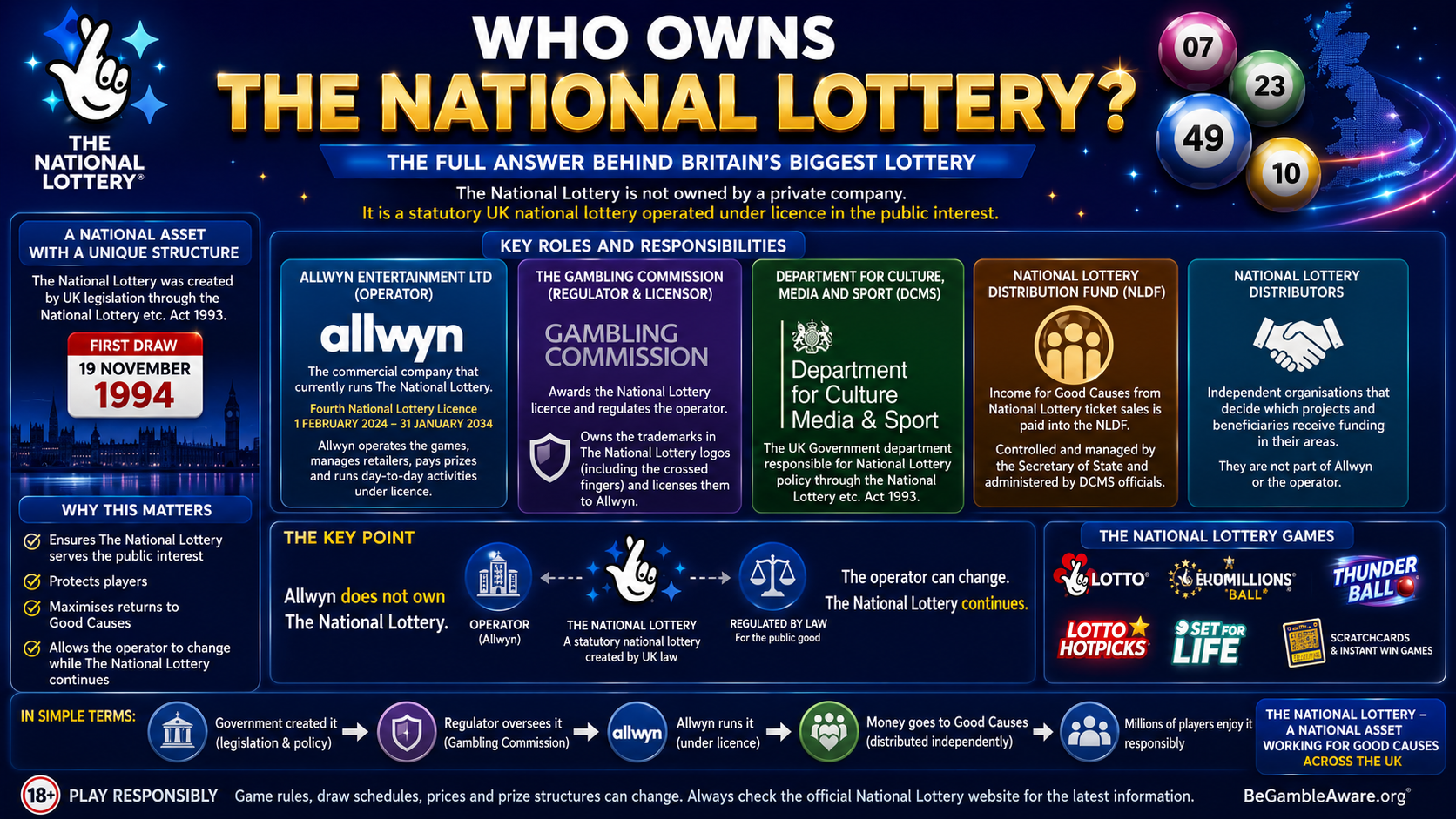
The National Lottery is unusual because there are several different organisations responsible for different parts of the system.
There is the company that operates it.
There is the regulator that licenses it.
There is the government department responsible for National Lottery policy.
There are separate organisations responsible for distributing money raised for Good Causes.
There is even a distinction between operating The National Lottery and ownership of The National Lottery trademarks and logos.
So who actually owns The National Lottery?
The most accurate answer is that The National Lottery is not privately owned in the conventional sense by its operator.
It is a national lottery established under UK legislation and operated by a private company under a time-limited licence awarded and regulated by the Gambling Commission.
Since 1 February 2024, that private operator has been Allwyn Entertainment Ltd.
Its licence currently runs until 31 January 2034.
But Allwyn has not simply bought The National Lottery and does not possess an indefinite right to run it.
When that licence expires, the right to operate Britain’s National Lottery can potentially pass to somebody else.
That is exactly what happened when Camelot lost the operating licence after running The National Lottery for almost 30 years.
Understanding that distinction explains almost everything about who really “owns” The National Lottery.
Does Allwyn Own The National Lottery?
Not in the straightforward sense in which a company owns one of its ordinary commercial brands.
Allwyn Entertainment Ltd is the licensed operator of The National Lottery.
The Gambling Commission states explicitly that The National Lottery is run by the commercial company Allwyn and that the legal entity holding the licence is Allwyn Entertainment Ltd.
The current National Lottery licence runs from 1 February 2024 until 31 January 2034.
That makes Allwyn enormously important.
It operates the lottery.
It manages the commercial system.
It sells and promotes National Lottery games under the terms of its licences.
It works with retailers.
It operates digital channels.
It administers prizes and much of the infrastructure players interact with.
But that is different from permanently owning The National Lottery itself.
Allwyn’s authority exists because it holds the licence.
If another organisation eventually wins a future National Lottery licence, the operator can change again.
So Who Owns The National Lottery?
There is no single answer unless we first define what “own” means.
If by ownership we mean:
Who currently runs The National Lottery?
The answer is:
Allwyn Entertainment Ltd.
If we mean:
Who decides which commercial company is allowed to run The National Lottery?
The answer is:
The Gambling Commission, operating within the statutory National Lottery framework.
If we mean:
Who owns The National Lottery trademarks and logos?
The answer becomes particularly interesting.
The Gambling Commission states that it owns the trademarks in The National Lottery logos and licenses them to Allwyn Entertainment Ltd.
That includes the famous crossed-fingers identity and game logos.
If we mean:
Who establishes National Lottery policy?
The Department for Culture, Media and Sport — DCMS — has a central government role.
And if we mean:
Who receives and distributes the money generated for Good Causes?
That involves yet another structure, including the National Lottery Distribution Fund and the designated National Lottery distributors.
This is why “Who owns The National Lottery?” cannot accurately be answered with the name of one private company.
The National Lottery Is a Statutory Creation
To understand the structure, we have to return to the beginning.
The modern National Lottery was established following the National Lottery etc. Act 1993.
It was not created in the ordinary way that an entrepreneur might establish a private lottery business and build a commercial brand around it.
Parliament established the legislative framework within which a national lottery could operate.
The first draw took place on 19 November 1994.
From the beginning, however, the government did not simply operate the lottery directly as another government department.
Instead, a private-sector operator was selected to run it under licence.
That operator was Camelot.
This created the unusual public-private structure that continues today.
The state creates and regulates the framework.
A commercial company operates the lottery under licence.
Players purchase tickets.
Prizes are paid.
Money is generated for Good Causes.
Independent distributors determine how much of that Good Causes funding is awarded.
The result is neither a conventional government department nor an ordinary privately owned lottery company.
Camelot Did Not Permanently Own The National Lottery Either
Camelot’s extraordinarily long tenure probably contributed to the impression that Camelot “owned” The National Lottery.
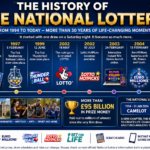
Camelot began operating it in 1994.
It continued operating it through the second licence.
Then the third licence.
Year followed year.
The National Lottery became synonymous with Camelot.
Someone who started buying National Lottery tickets in 1994 could still be buying tickets from a Camelot-operated National Lottery almost three decades later.
That is an unusually long period of continuity for a licensed operator.
But Camelot’s position depended upon licences.
It did not possess The National Lottery forever.
And eventually that distinction became extremely important.
The Competition for the Fourth National Lottery Licence
The right to operate The National Lottery is extraordinarily valuable.
It is one of the largest lotteries in the world, with enormous annual ticket sales and one of the most recognisable consumer brands in Britain.
Consequently, the competition to operate it is a major commercial event.
The Gambling Commission ran a competition for the Fourth National Lottery Licence.
Camelot wanted to continue.
Other organisations wanted to replace it.
Ultimately, the Gambling Commission selected Allwyn.
That decision demonstrated in the clearest possible way why the operator and The National Lottery itself are not the same thing.
Camelot had operated The National Lottery since 1994.
But Camelot could lose the right to operate it.
And it did.
Allwyn Takes Over
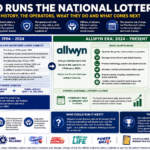
On 1 February 2024, the Fourth National Lottery Licence came into effect.
Allwyn formally became the new operator.
For the first time since the National Lottery began, the company running it changed.
Camelot was out.
Allwyn was in.
Yet The National Lottery did not disappear.
Lotto remained Lotto.
EuroMillions remained available.
Thunderball continued.
Set For Life continued.
Scratchcards continued.
Retailers continued selling National Lottery products.
Players continued using The National Lottery.
The operator had changed.
The National Lottery had not.
That is perhaps the clearest demonstration of the difference between owning a private business and holding the licence to operate The National Lottery.
Allwyn’s Licence Is Temporary
Allwyn’s current licence began on 1 February 2024.
It runs until 31 January 2034.
Ten years is obviously a substantial period.
But it has an end date.
Allwyn therefore does not possess an unrestricted perpetual right to operate The National Lottery.
Its rights and responsibilities exist within the terms of the Fourth National Lottery Licence and the surrounding statutory framework.
That is fundamentally different from conventional corporate ownership.
If a company owns a privately created brand, there normally isn’t a regulator waiting for a fixed date at which another company can compete for the right to take that brand over.
The National Lottery is different.
Could Someone Else Run The National Lottery After 2034?
Potentially, yes.
What happens beyond the current licence will depend upon the future regulatory and legislative arrangements.
But history has already established the central principle:
the operator can change.
Camelot demonstrated that.
After almost three decades as operator, it was replaced.
There is therefore no reason to describe Allwyn as the permanent owner of The National Lottery.
It is the current licensed operator.
That distinction is important.
Who Is Allwyn?
Allwyn Entertainment Ltd is the UK legal entity that holds the National Lottery licence.
It forms part of the wider Allwyn international lottery group.
Allwyn describes itself as a global lottery operator with operations and interests across several markets.
For UK National Lottery purposes, however, the important company is Allwyn Entertainment Ltd.
This is the entity licensed to operate The National Lottery in Britain.
So if somebody asks:
“Which company runs The National Lottery?”
Allwyn Entertainment Ltd is the straightforward answer.
That is different from asking:
“Who owns The National Lottery?”
Who Owns Allwyn?
This adds another layer to the question.
Allwyn forms part of a wider international corporate group.
That corporate group has its own shareholders and ultimate ownership structure.
Those owners have an economic interest in Allwyn.
But owning the company that currently holds the National Lottery licence does not mean those shareholders privately own Britain’s National Lottery as a permanent asset.
They own interests in the corporate group whose UK subsidiary currently has the contractual and regulatory right to operate it.
Again, the distinction matters.
Allwyn can own its own corporate assets.
Its shareholders can own Allwyn.
But The National Lottery licence remains a regulated right with an expiry date.
Who Owns The National Lottery Logo?
Here the answer becomes surprisingly specific.
The famous National Lottery crossed-fingers logo is not simply an Allwyn corporate trademark.
The Gambling Commission owns the trademarks in The National Lottery logos.
The Commission licenses those trademarks to Allwyn Entertainment Ltd so that Allwyn can use them while operating The National Lottery.
This is a particularly useful clue to the real structure.
If Allwyn simply owned The National Lottery outright, there would be little reason for the regulator to own key National Lottery trademarks and license them back to the operator.
Instead, the structure helps protect continuity of The National Lottery brand even when the commercial operator changes.
Camelot can leave.
Allwyn can arrive.
The National Lottery identity remains.
Who Owns the Crossed-Fingers Logo?
The famous crossed-fingers National Lottery identity is part of the protected National Lottery brand.
The Gambling Commission states that it owns the trademarks in National Lottery logos and licenses them to Allwyn.
This arrangement also helps explain why National Lottery-funded projects can use authorised versions of National Lottery branding.
The brand represents something larger than the commercial company operating the lottery at any particular moment.
Does the UK Government Own The National Lottery?
This is where terminology becomes difficult.
It is tempting to simplify everything and say:
“The government owns The National Lottery.”
That is closer to understanding the public nature of the system than saying Allwyn simply owns it, but it still requires qualification.
The National Lottery exists under legislation.
Government, through the Department for Culture, Media and Sport, is responsible for the relevant policy framework.
The Secretary of State has statutory functions relating to the National Lottery.
The Gambling Commission licenses and regulates the operator.
But The National Lottery is not operated day-to-day as a government department.
A commercial company operates it.
Currently, that company is Allwyn Entertainment Ltd.
The most precise description is therefore that The National Lottery is a statutory national lottery operated commercially under government-established legislation and regulatory licence.
What Does DCMS Do?
The Department for Culture, Media and Sport, usually abbreviated to DCMS, is the government department responsible for National Lottery policy.
Allwyn itself describes DCMS as the government department responsible for setting policy for The National Lottery through the National Lottery etc. Act 1993.
This means government sits above the purely commercial operation in the overall structure.
Allwyn runs the lottery.
The Gambling Commission regulates and licenses it.
DCMS has responsibility for the underlying government policy framework.
Those are three distinct functions.
What Does the Gambling Commission Do?
The Gambling Commission has another distinct role.
It is responsible for regulating The National Lottery.
Its statutory responsibilities include ensuring that the lottery is run with due propriety, protecting participants and seeking to maximise returns to Good Causes.
Crucially, the Gambling Commission also awards the licence to run The National Lottery.
That is the mechanism through which a commercial operator receives authority to run it.
The Commission also grants licences for individual games or classes of games forming part of The National Lottery.
So Allwyn cannot simply decide that because it currently operates The National Lottery, it can do whatever it wishes with it.
Its operation exists inside a substantial licensing and regulatory framework.
Who Controls National Lottery Games?
This is another area where the word “owner” becomes inadequate.
Allwyn operates and develops the commercial National Lottery offering, but individual games exist within the licensing framework.
The Gambling Commission grants licences covering games and classes of games promoted as part of The National Lottery.
This remains a live process rather than something that happened once in 1994.
For example, in 2026 the Commission approved significant changes involving Lotto and Lotto HotPicks and issued a new Section 6 licence allowing Allwyn to introduce the US draw-based game Powerball to the UK National Lottery portfolio.
That illustrates the continuing relationship between operator and regulator.
The operator proposes and operates.
The regulator licenses and oversees.
Who Owns the Money Players Spend?
This also requires a distinction.
When a player spends money on a National Lottery ticket, that entire amount does not simply become Allwyn’s revenue to keep.
National Lottery ticket revenue ultimately has several destinations.
Money funds prizes.
Money goes towards Good Causes.
Lottery Duty is paid.
Retailers and operating costs have to be accounted for.
The licensed operator receives its economic return within this regulated structure.
This is very different from imagining that every pound spent on National Lottery tickets belongs to the private company operating the lottery.
Who Owns the Money for Good Causes?
Money generated for Good Causes is handled separately.
Income raised for Good Causes from National Lottery ticket sales is paid by the operator into the National Lottery Distribution Fund, usually abbreviated to NLDF.
The NLDF was established under the National Lottery etc. Act 1993.
The Secretary of State controls and manages the Fund, while DCMS officials administer it.
This money is therefore not simply an Allwyn corporate fund.
Allwyn does not get to decide that money intended for Good Causes should instead become corporate profit.
The structure deliberately separates Good Causes funding from the commercial operator.
Who Decides Where National Lottery Good Causes Money Goes?
Not Allwyn.
This is another important misconception.
National Lottery Good Causes money is distributed through designated distribution bodies.
These organisations decide which projects and beneficiaries receive funding within their respective areas.
The operator raises and transfers the relevant money through the National Lottery system.
It does not personally select every village hall, charity, sports organisation, heritage project or community initiative that receives a grant.
That separation is an important part of the National Lottery structure.
So Does Allwyn Keep the Profits?
Allwyn is a commercial company.
It operates The National Lottery for profit.
But the Fourth Licence deliberately connects its commercial incentives more closely with returns to Good Causes.
When the Fourth Licence began, the Gambling Commission explained that the new incentive mechanism means Allwyn’s profits rise when returns to Good Causes rise.
This is another example of the unusual structure.
The operator is commercial.
But it operates within a framework designed to align commercial success with the wider objectives of The National Lottery.
Is The National Lottery Public or Private?
The most useful answer is:
It contains elements of both.
The statutory framework is public.
National Lottery policy involves government.
The regulator is a public body.
The operating licence is awarded by the Gambling Commission.
The National Lottery brand and trademarks are protected separately from the commercial operator.
Good Causes funding enters a statutory distribution structure.
But the actual day-to-day commercial operation is undertaken by a private company.
That company is currently Allwyn Entertainment Ltd.
The National Lottery is therefore best understood as a publicly established and regulated national institution operated through a private-sector licence.
Is The National Lottery State Owned?
Calling it simply a “state-owned company” would be inaccurate.
Allwyn is not a state-owned company.
It is a commercial operator.
The National Lottery is also not organised as though the government owned 100% of the shares in a company called “The National Lottery plc” and simply employed people to sell tickets.
Instead, Parliament created the statutory framework and the right to operate the lottery is licensed to a private-sector company.
That is a materially different model.
Is Allwyn Like a Franchisee?
There are some conceptual similarities, but “franchise” is not the correct legal description.
Allwyn holds the Fourth National Lottery Licence.
Thinking about it as a franchise can nevertheless help explain the difference between the underlying National Lottery and the company currently running it.
Imagine a valuable national commercial right being awarded for a fixed period.
The operator gets the right and responsibility to run it.
It must comply with extensive conditions.
At the end of the period, the right can potentially pass elsewhere.
That is much closer to reality than simply saying:
“Allwyn owns The National Lottery.”
Why Did Camelot Lose The National Lottery?
Camelot’s tenure ended because it did not win the Fourth National Lottery Licence competition.
The Gambling Commission selected Allwyn as the preferred applicant and subsequently awarded it the licence.
This decision was challenged through litigation.
As of 2026, the High Court rejected the legal challenges brought by The New Lottery Company Limited and Northern & Shell in relation to the Fourth Licence award.
The Gambling Commission has continued regulating Allwyn as the current operator.
The important point for ownership is that Camelot’s departure proves that operating The National Lottery is a transferable licensed role.
Did Allwyn Buy The National Lottery From Camelot?
No.
This is another crucial distinction.
The transition was not fundamentally Camelot selling ownership of The National Lottery to Allwyn.
Allwyn won the competition for the Fourth National Lottery Licence.
Camelot’s previous licence expired.
Allwyn’s new licence began.
That is a very different transaction from one company simply acquiring another company’s privately owned brand.
But Didn’t Allwyn Buy Camelot?
There is an interesting corporate twist.
The wider Allwyn group did acquire Camelot UK and Camelot Lottery Solutions before the transition to the Fourth Licence was completed.
That corporate acquisition can make the ownership question appear even more confusing.
But the legal right to operate The National Lottery under the Fourth Licence came from the Gambling Commission’s licensing competition and licence award.
It did not arise simply because Allwyn acquired Camelot.
The two issues need to be kept separate.
What Exactly Did Camelot Own?
Camelot was a commercial company with its own corporate assets, employees, systems, intellectual property, contracts and business interests.
But its authority to operate The National Lottery depended upon the National Lottery licence.
When the Third Licence expired on 31 January 2024, the era of Camelot operating The National Lottery ended.
The Fourth Licence began the following day.
This is another reason why saying Camelot “owned The National Lottery” throughout 1994–2024 was always an oversimplification.
What Exactly Does Allwyn Own?
Allwyn owns the assets belonging to its corporate group and conducts the commercial operation of The National Lottery through Allwyn Entertainment Ltd.
But its ability to promote National Lottery games and use protected National Lottery branding exists under licences and regulatory arrangements.
The National Lottery’s identity is therefore deliberately capable of surviving a change in operator.
That happened in 2024.
It could happen again.
Why Is The National Lottery Structured This Way?
The National Lottery is unusual because it needs to achieve several objectives simultaneously.
It needs to attract players.
It needs to pay prizes.
It needs to operate commercially and efficiently.
It needs to protect participants.
It needs to maintain public confidence.
And it is expected to maximise returns for Good Causes within the statutory framework.
Using a commercial operator provides private-sector operating expertise and commercial incentives.
Using legislation, licensing and regulation protects the wider public purpose of the lottery.
Separating Good Causes distribution prevents the commercial operator from controlling the entire funding process.
The structure therefore deliberately divides power.
Who Is Ultimately in Charge?
Even this question requires context.
Allwyn is in charge of operating the lottery within its licence.
The Gambling Commission is responsible for licensing and regulating it.
DCMS is responsible for government policy relating to The National Lottery.
The Secretary of State has statutory responsibilities.
National Lottery distributors determine how Good Causes money is awarded.
No single one of those organisations performs every function.
That is intentional.
Could the Government Simply Take Over The National Lottery?
The way The National Lottery is operated is determined by legislation and the regulatory framework in force at the time.
Major changes to that framework would therefore involve government and potentially Parliament rather than being a commercial decision available to Allwyn.
Allwyn cannot decide that it permanently owns the institution.
Equally, another private company cannot simply launch a takeover bid for “The National Lottery” and automatically acquire the right to operate it.
The operating right is regulated.
Could Allwyn Sell The National Lottery?
Not as though The National Lottery were an ordinary privately owned brand.
Allwyn cannot simply sell the National Lottery operating right to whichever company offers the highest price and thereby bypass the Gambling Commission.
The licence and operator are subject to regulatory requirements.
Corporate transactions involving the operator are therefore fundamentally different from the unrestricted sale of an ordinary private business.
What Happens in 2034?
The current Fourth National Lottery Licence is scheduled to expire on 31 January 2034.
What follows will depend upon the framework and decisions made for the next operating period.
Allwyn might potentially remain involved.
Another company might eventually operate it.
The regulatory structure could evolve.
The government could make policy changes.
What we can say now is that Allwyn’s current operating right is not perpetual.
There is a date attached to it.
Could Camelot Ever Run The National Lottery Again?
In principle, future National Lottery operating arrangements depend upon whatever competition and eligibility framework applies at the relevant time.
But the more important point is that the identity of the operator is not permanently fixed.
For nearly 30 years it appeared to be.
Then 1 February 2024 proved otherwise.
The National Lottery survived the change from Camelot to Allwyn because the institution is bigger than its operator.
Who Owns Lotto?
Lotto is a National Lottery game.
Allwyn currently operates and promotes it under the relevant National Lottery licensing framework.
But describing Lotto simply as an ordinary Allwyn-owned commercial lottery again misses the regulatory structure.
The Gambling Commission grants licences covering National Lottery games.
The National Lottery brand and game logos are also protected through the Commission’s trademark ownership and licensing arrangements.
Who Owns EuroMillions?
EuroMillions is more complicated again because it is a multinational game involving participating lottery organisations across several European countries.
In Britain, EuroMillions is offered as part of The National Lottery under the UK National Lottery framework.
Allwyn operates the UK participation.
But EuroMillions itself is not simply a British Allwyn lottery.
Players in France, Spain, Ireland, Austria, Belgium, Luxembourg, Portugal and Switzerland also participate through their respective lottery organisations.
Who Owns Thunderball?
Thunderball forms part of The National Lottery portfolio and is currently operated by Allwyn Entertainment Ltd under the applicable National Lottery licensing arrangements.
Again, it sits within the wider National Lottery system rather than simply being an unrestricted private lottery belonging permanently to Allwyn.
Who Owns Set For Life?
Set For Life is another National Lottery game currently operated by Allwyn under the National Lottery licensing framework.
Its position follows the same broader principle.
The operator can change without the entire National Lottery necessarily disappearing.
Who Owns National Lottery Scratchcards?
National Lottery scratchcards are products operated and sold as part of The National Lottery.
Allwyn currently manages that commercial operation under the Fourth Licence.
But the National Lottery identity under which those products are offered remains part of the regulated National Lottery framework.
What Would Happen if Allwyn Lost Its Licence?
The exact circumstances would determine what happened next.
But the historical Camelot-to-Allwyn transition demonstrates the principle.
A National Lottery can continue while its operator changes.
Infrastructure, systems, contracts and operational arrangements may need to transfer or transition.
But losing the licence does not mean that Britain’s National Lottery automatically ceases to exist.
Is The National Lottery a National Asset?
The Gambling Commission has described The National Lottery as a national asset.
That terminology is useful.
It captures the idea that the lottery is intended to endure beyond whichever private company happens to operate it during a particular licence period.
Camelot was temporary, even though its tenure lasted almost 30 years.
Allwyn is the current custodian and commercial operator.
The National Lottery itself is intended to continue.
Who Really Owns The National Lottery? The Simple Answer
If someone asks the question casually, the answer can be stated like this:
Allwyn currently runs The National Lottery, but it does not simply own it outright. The National Lottery is a statutory UK national lottery operated under a licence awarded by the Gambling Commission.
That is considerably more accurate than saying:
“Allwyn owns it.”
The More Complete Answer
The full structure looks like this.
The National Lottery
is the overarching statutory national lottery established under UK law.
Allwyn Entertainment Ltd
is the commercial company currently licensed to operate it.
The Gambling Commission
licenses and regulates The National Lottery and owns the trademarks in its logos, which it licenses to the operator.
The Department for Culture, Media and Sport
is responsible for government policy relating to The National Lottery.
The Secretary of State
has statutory responsibilities and controls and manages the National Lottery Distribution Fund.
The National Lottery Distribution Fund
receives money generated for Good Causes.
National Lottery distributors
make funding decisions within their respective areas.
That is why there is no single company that can accurately be described as owning every component of The National Lottery.
Why “Who Owns The National Lottery?” Is Such a Good Question
The question exposes something that is easy to overlook.
For almost three decades, Camelot and The National Lottery appeared almost inseparable.
Then Camelot stopped operating it.
The National Lottery continued.
That tells us something fundamental.
The operator is replaceable.
The lottery is the enduring institution.
Allwyn now occupies the position Camelot once occupied.
It runs one of the largest lottery operations in the world.
It has enormous commercial responsibilities.
It will shape the development of The National Lottery throughout the Fourth Licence.
But the licence has an expiry date.
The National Lottery does not.
The National Lottery Is Bigger Than Its Operator
Perhaps the best way to understand ownership is therefore to stop thinking of The National Lottery as an ordinary company.
It is better understood as a regulated national system.
Parliament created the framework.
Government determines policy.
The Gambling Commission regulates it and awards the operating licence.
A private company operates it.
Good Causes money is separated into a statutory distribution system.
Independent distributors allocate funding.
And the operating company can change.
Camelot demonstrated that in 2024.
For almost 30 years, Camelot ran The National Lottery.
Then its licence ended.
Allwyn took over.
The crossed-fingers logo remained.
Lotto remained.
EuroMillions remained.
Thunderball remained.
Set For Life remained.
Millions of players continued buying tickets.
The National Lottery continued raising money for Good Causes.
The company changed.
The institution survived.
So, Who Owns The National Lottery in 2026?
The best answer for E-Lotto.co.uk is:
No private company simply owns The National Lottery outright.
The National Lottery exists under UK statute and is operated under a regulatory licensing system.
Allwyn Entertainment Ltd currently operates it under the Fourth National Lottery Licence, running from 1 February 2024 until 31 January 2034.
The Gambling Commission regulates The National Lottery, awards its operating and game licences and owns the trademarks in the National Lottery logos, licensing them to Allwyn.
The Department for Culture, Media and Sport is responsible for National Lottery policy, while the National Lottery Distribution Fund and designated distributors form the separate system through which money raised for Good Causes is held and distributed.
So if someone asks:
“Does Allwyn own The National Lottery?”
The answer is:
Not outright. Allwyn is the current licensed operator.
If someone asks:
“Did Camelot own it?”
Again:
Camelot was the licensed operator, not the permanent owner of Britain’s National Lottery.
And if somebody asks:
“Does the government own it?”
The answer requires qualification too.
The National Lottery is a statutory national institution operating within a government-created policy and regulatory framework, but its commercial operation is contracted through a private licensed operator rather than being directly run as a government department.
That complicated arrangement is not an accident.
It is one of the defining features of The National Lottery.
The operator can change.
The regulator remains.
The statutory framework remains.
The Good Causes structure remains.
And The National Lottery continues.
For E-Lotto.co.uk readers, that is the key distinction:
Allwyn runs The National Lottery today. It does not simply own Britain’s National Lottery forever.
Current National Lottery ownership, licensing, regulatory and corporate arrangements can change. This E-Lotto.co.uk guide reflects the structure in 2026 and should be read alongside current information from the Gambling Commission and UK Government.
FAQ: Who Owns The National Lottery
- Who owns The National Lottery?
The National Lottery is not owned outright by a private company in the conventional sense. It is a statutory UK national lottery created under legislation and operated by a private company under licence.
- Who currently runs The National Lottery?
Allwyn Entertainment Ltd currently operates The National Lottery.
- When did Allwyn start running The National Lottery?
Allwyn became the operator on 1 February 2024.
- Who ran The National Lottery before Allwyn?
Camelot operated The National Lottery from its launch in 1994 until 31 January 2024.
- Did Camelot own The National Lottery?
No. Camelot was the licensed operator rather than the permanent owner of The National Lottery.
- Does Allwyn own The National Lottery?
Not outright. Allwyn holds the current licence to operate The National Lottery.
- What is the difference between owning and operating The National Lottery?
Ownership would imply permanent control of the asset. Operating The National Lottery means holding a regulated licence to run it for a defined period.
- How long does Allwyn’s licence last?
The Fourth National Lottery Licence runs from 1 February 2024 until 31 January 2034.
- Can another company run The National Lottery after 2034?
Potentially, yes. Future operating arrangements will depend on the licensing and regulatory framework in place at the time.
- Who awards the licence to run The National Lottery?
The Gambling Commission awards and regulates the National Lottery operating licence.
- What does the Gambling Commission do?
It regulates The National Lottery, oversees the licensed operator and is responsible for key licensing functions.
- Is the Gambling Commission the owner of The National Lottery?
Not in the ordinary commercial sense. It is the regulator and also owns trademarks in National Lottery logos.
- Who owns The National Lottery logos?
The Gambling Commission owns trademarks in The National Lottery logos and licenses them to the operator.
- Does that include the crossed-fingers National Lottery logo?
Yes. The famous crossed-fingers National Lottery branding forms part of the protected National Lottery trademark structure.
- Why does the Gambling Commission own the logos?
This helps preserve continuity of The National Lottery brand independently of whichever private company currently operates it.
- Does Allwyn own the crossed-fingers logo?
No. Allwyn is licensed to use National Lottery branding while operating the lottery.
- Who is responsible for National Lottery policy?
The Department for Culture, Media and Sport, commonly known as DCMS, is responsible for government policy relating to The National Lottery.
- Is The National Lottery run by the government?
No. It is commercially operated by Allwyn under a government-created statutory and regulatory framework.
- Is The National Lottery state owned?
Calling it simply state owned would be misleading. It is a statutory national lottery operated by a private licensed company.
- Is Allwyn a government company?
No. Allwyn is a private commercial company.
- Is The National Lottery a private company?
No. The National Lottery itself is not simply a conventional privately owned company.
- How should The National Lottery be described?
It is best described as a statutory national lottery operated commercially under licence and regulated in the public interest.
- When was The National Lottery created?
Its legal framework was established by the National Lottery etc. Act 1993.
- When did The National Lottery actually start?
The first National Lottery draw took place on 19 November 1994.
- Who operated the first National Lottery draw?
Camelot operated the first National Lottery draw.
- How long did Camelot operate it?
Camelot ran The National Lottery for almost 30 years.
- Why did people think Camelot owned The National Lottery?
Camelot operated it continuously from 1994 until 2024, so the company and the lottery became closely associated in the public mind.
- Why did Camelot stop running The National Lottery?
Camelot did not win the competition for the Fourth National Lottery Licence.
- Who won the Fourth National Lottery Licence?
Allwyn won the licence.
- Was The National Lottery sold to Allwyn?
No. The change of operator occurred through the licensing process rather than a straightforward sale of The National Lottery.
- Did Allwyn buy Camelot?
The wider Allwyn group acquired Camelot UK, but that corporate acquisition is separate from the award of the Fourth National Lottery Licence.
- Did buying Camelot automatically give Allwyn the right to run The National Lottery?
No. The right to operate The National Lottery came from the Fourth National Lottery Licence.
- Could Camelot have continued if it had won the licence?
Yes. Had Camelot won the Fourth Licence competition, it could have continued as operator.
- Can The National Lottery survive a change of operator?
Yes. The 2024 transition from Camelot to Allwyn proved that the lottery can continue when its operator changes.
- What stayed the same when Allwyn took over?
The National Lottery continued operating, including familiar games, retail distribution, online services and Good Causes funding.
- Did Lotto disappear when Camelot left?
No. Lotto continued under Allwyn.
- Did EuroMillions disappear when Camelot left?
No. UK participation in EuroMillions continued.
- Did Thunderball continue?
Yes. Thunderball remained part of The National Lottery portfolio.
- Did Set For Life continue?
Yes. Set For Life also continued.
- What does that tell us about ownership?
It shows that The National Lottery is separate from the private company that happens to operate it at any particular time.
- Who owns Lotto?
Lotto is a National Lottery game operated under the National Lottery licensing framework rather than a conventional privately owned standalone lottery.
- Who owns Thunderball?
Thunderball is part of The National Lottery portfolio and is currently operated by Allwyn under licence.
- Who owns Set For Life?
Set For Life is another National Lottery game operated within the licensed National Lottery system.
- Who owns Lotto HotPicks?
Lotto HotPicks is part of The National Lottery and operates under the same broad licensed structure.
- Who owns National Lottery scratchcards?
National Lottery scratchcards are products operated as part of The National Lottery rather than a permanently private Allwyn-owned lottery brand.
- Who owns EuroMillions?
EuroMillions is a multinational lottery involving several participating national lottery organisations, so it is not owned solely by Allwyn or the UK National Lottery.
- Who operates EuroMillions in the UK?
Allwyn operates the UK side of EuroMillions through The National Lottery.
- Is EuroMillions a British lottery?
No. It is a multinational European lottery.
- Does Allwyn control EuroMillions across Europe?
No. Other participating countries have their own authorised lottery operators.
- Who controls which National Lottery games can be offered?
The operator works within a regulatory licensing framework overseen by the Gambling Commission.
- Can Allwyn launch any National Lottery game it wants?
No. National Lottery games are subject to regulatory and licensing requirements.
- Does the Gambling Commission approve games?
The Commission has licensing responsibilities relating to games and classes of games within The National Lottery.
- Who decides how The National Lottery is regulated?
The framework is established through legislation, government policy and Gambling Commission regulation.
- Can Allwyn ignore National Lottery rules?
No. It must comply with its licence conditions and the wider regulatory framework.
- Can the Gambling Commission take action against the operator?
Yes. The operator is subject to regulatory oversight and enforcement mechanisms.
- Who owns the money spent on National Lottery tickets?
Ticket revenue is distributed through a regulated structure rather than simply becoming unrestricted money for the operator.
- Does Allwyn keep all ticket sales?
No.
- Where does National Lottery ticket money go?
It is allocated across prizes, Good Causes, Lottery Duty, retail and operating costs under the applicable arrangements.
- Does Allwyn decide how much Good Causes money it keeps?
No. Good Causes funding is part of the regulated National Lottery financial structure.
- What is the National Lottery Distribution Fund?
The National Lottery Distribution Fund, or NLDF, is the fund into which money raised for Good Causes is paid.
- Who controls the National Lottery Distribution Fund?
It is controlled and managed within the government framework, with DCMS involved in its administration.
- Does Allwyn own the National Lottery Distribution Fund?
No.
- Can Allwyn spend Good Causes money however it wants?
No.
- Who decides which projects receive National Lottery funding?
Designated National Lottery distributors make funding decisions in their respective areas.
- Are the distributors part of Allwyn?
No. They are separate from the commercial operator.
- What types of projects receive National Lottery Good Causes funding?
Funding supports areas including communities, arts, heritage and sport.
- Does the government personally select every funded project?
No. Funding decisions are generally made by designated distribution bodies.
- Why is Good Causes money kept separate?
Separating it from the commercial operator helps protect the public-purpose element of The National Lottery.
- Does Allwyn operate The National Lottery for profit?
Yes. Allwyn is a commercial company and operates the lottery as a business under licence.
- Does that mean it privately owns the lottery?
No. Commercial operation does not equal permanent ownership.
- How does Allwyn make money from The National Lottery?
Its commercial return is generated through the arrangements established under the Fourth National Lottery Licence.
- Is Allwyn’s profit unrestricted?
No. Its operation and incentives exist within the licence and regulatory structure.
- Is The National Lottery a public-private partnership?
That is a useful broad description, although the precise legal structure is a statutory lottery operated by a private company under licence.
- Is The National Lottery a national asset?
The Gambling Commission has described The National Lottery as a national asset.
- What does “national asset” mean in this context?
It reflects the idea that The National Lottery is intended to endure beyond the tenure of any single commercial operator.
- Does the government own shares in Allwyn?
Allwyn is a private commercial company rather than a government-owned operating company.
- Who owns Allwyn?
Allwyn forms part of a wider private international lottery and gaming group with its own corporate ownership structure.
- Does whoever owns Allwyn also own The National Lottery?
No. They own interests in the company that currently operates The National Lottery, not the statutory lottery itself outright.
- Could Allwyn sell The National Lottery?
Not as though it were an ordinary privately owned brand.
- Could Allwyn transfer its National Lottery licence to anyone it chooses?
No. The licence and operator are subject to regulatory controls.
- Could someone buy Allwyn and automatically gain permanent ownership of The National Lottery?
No. Corporate ownership of Allwyn does not convert the National Lottery licence into a permanent private asset.
- Why does the licence have an end date?
The operating right is intentionally time limited so the National Lottery operator remains subject to future licensing decisions.
- What happens when the licence expires?
Future arrangements will determine who operates The National Lottery during the next licence period.
- Could Allwyn win another licence?
Potentially, depending on the future competition and regulatory framework.
- Could a different company take over?
Yes. The transition from Camelot to Allwyn shows that this can happen.
- Would The National Lottery need a new name if the operator changed?
Not necessarily. The National Lottery brand exists independently of the current operator.
- Would the crossed-fingers logo necessarily disappear?
Not simply because the operator changed. The branding is protected separately from the operator.
- Who is ultimately responsible for the statutory framework?
Parliament created the legislative framework, while government and the regulator have ongoing responsibilities.
- What role does Parliament have?
Parliament established the legal basis for The National Lottery through legislation and can legislate further if the framework needs to change.
- What role does DCMS have?
DCMS is responsible for government policy relating to The National Lottery.
- What role does the Secretary of State have?
The Secretary of State has statutory responsibilities connected with The National Lottery and the Good Causes funding framework.
- What role does Allwyn have?
Allwyn is responsible for the day-to-day commercial operation of The National Lottery under the Fourth Licence.
- What role does the Gambling Commission have?
It licenses and regulates The National Lottery and oversees the operator.
- What role do National Lottery distributors have?
They decide how Good Causes funding is awarded within their respective remits.
- So is there one organisation that controls everything?
No. Responsibility is deliberately divided between the operator, regulator, government and Good Causes distribution bodies.
- Why is the structure so complicated?
The National Lottery combines commercial operation with public-interest objectives, player protection, taxation and Good Causes funding, so responsibilities are deliberately separated.
- Is it correct to write “Allwyn owns The National Lottery”?
That wording is too simplistic and can be misleading. “Allwyn operates The National Lottery under licence” is more accurate.
- Is it correct to write “the government owns The National Lottery”?
That also needs qualification. The National Lottery is established and governed through public law and policy, but its day-to-day operation is carried out by a private licensed company.
- What is the best one-sentence answer to “Who owns The National Lottery?”
No private company owns The National Lottery outright; it is a statutory UK national lottery currently operated by Allwyn Entertainment Ltd under a time-limited licence awarded and regulated by the Gambling Commission.
- Who really owns The National Lottery?
The most accurate answer is that The National Lottery does not have a single conventional private owner. It exists under UK legislation as a national lottery, with government responsible for the policy framework, the Gambling Commission responsible for licensing and regulation, Allwyn Entertainment Ltd currently responsible for commercial operation under the Fourth National Lottery Licence, and separate organisations responsible for distributing money raised for Good Causes. Allwyn therefore runs The National Lottery today, but it does not own Britain’s National Lottery forever. The operator can change while The National Lottery itself continues.