
When Did the National Lottery Start?

When Did the National Lottery Start? The Complete History of the UK National Lottery From 1994 to Today
The UK National Lottery started in 1994, with the first National Lottery draw taking place on Saturday 19 November 1994.
That is the simple answer.
The complete story is considerably bigger.
What began in November 1994 as a single Saturday-night lottery draw has developed over more than three decades into a collection of draw-based games, scratchcards, online Instant Win Games and multinational participation through EuroMillions.
Lotto, Thunderball, EuroMillions, Lotto HotPicks and Set For Life did not all begin together. They arrived at different stages of National Lottery history, while other games were introduced, modified, renamed and eventually withdrawn.
The organisation behind the National Lottery has changed too. Camelot operated it from its beginning in 1994 until 2024. On 1 February 2024, Allwyn began operating The National Lottery under the fourth National Lottery licence.
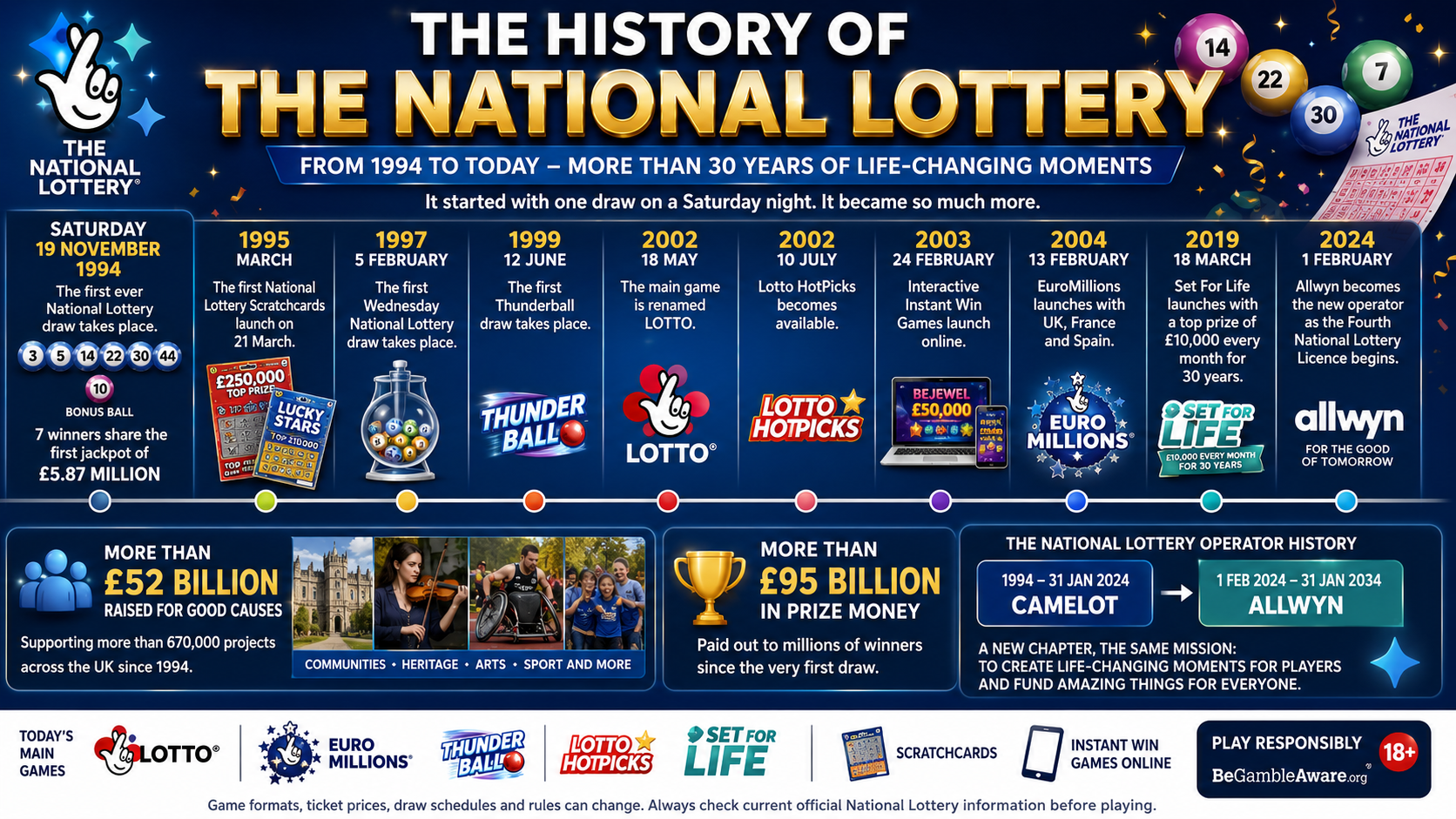
The National Lottery itself therefore has a history that can be divided into several distinct eras: its creation by Parliament, the first Lotto-style draw in 1994, the arrival of scratchcards in 1995, the Wednesday draw in 1997, Thunderball in 1999, online and interactive games in the early 2000s, Lotto HotPicks in 2002, EuroMillions in 2004, Set For Life in 2019 and finally the first change of operator in National Lottery history in 2024.
More than 30 years after the first balls were drawn, The National Lottery has become one of the most recognisable institutions in Britain.
Before the National Lottery
Britain had lotteries centuries before the modern National Lottery.
The idea of raising money through lottery games was therefore nothing new when the modern National Lottery was created.
What was different was the concept of establishing a permanent, nationwide lottery capable of simultaneously awarding substantial prizes and generating substantial funding for public-benefit projects.
The legal foundations were laid by the National Lottery etc. Act 1993.
The government’s original vision was for a lottery that would generate money for good causes, operate nationwide and be genuinely national, with at least one game available throughout the United Kingdom.
That legislation provided the framework from which the modern National Lottery emerged.
The important distinction is therefore that 1993 represents the legislative birth of the modern National Lottery, while 1994 represents its operational beginning.
1994: The National Lottery Is Born
The decisive year was 1994.
Camelot was selected to operate the new lottery and was awarded the first operating licence during 1994.
According to the Gambling Commission’s historical timeline, the first UK National Lottery licence was awarded on 25 May 1994. The formal seven-year operating licence was subsequently granted to Camelot Group plc on 29 July 1994.
The process moved quickly.
The first licence covering the initial online draw game was granted on 8 November 1994, and the National Lottery was formally launched at the Tower of London on Monday 14 November 1994.
Britain was only days away from its first National Lottery draw.
When Was the First National Lottery Draw?
The first National Lottery draw took place on:
Saturday 19 November 1994.
This is the date generally regarded as the beginning of National Lottery draw history.
The first winning main numbers were:
3, 5, 14, 22, 30 and 44
and the Bonus Ball was:
10.
Seven jackpot-winning tickets shared the first jackpot, which totalled approximately £5.87 million.
It was the beginning of something that would become deeply embedded in British popular culture.
The National Lottery Becomes Saturday-Night Television
The early National Lottery was not simply a mechanism for buying a ticket and checking some numbers.
The draw was a television event.
The National Lottery became associated with Saturday-night entertainment and BBC television, turning the actual drawing of the balls into a piece of prime-time programming.
The Gambling Commission records that more than 20 million people watched the launch of the first National Lottery draw on prime-time television.
For anyone who remembers British television during the 1990s, the National Lottery became part of the rhythm of the weekend.
People bought tickets during the week.
Saturday arrived.
Millions watched the draw.
Then tickets were checked against the numbers.
Long before smartphones, apps, automatic email notifications and online accounts, this was a highly visible national ritual.
“It Could Be You”
The National Lottery’s original identity became inseparable from the phrase:
“It Could Be You.”
The slogan captured the basic attraction of the game extraordinarily effectively.
Someone was going to win.
It might be somebody watching the draw.
It might be somebody in your town.
It might be somebody at work.
It might be you.
The modern Lotto section of The National Lottery still describes Lotto as the nation’s first and favourite draw game and references its history of making millionaires since 1994.
That continuity is important because today’s Lotto is the direct descendant of the original 1994 National Lottery draw.
The Original National Lottery Game
When the National Lottery began, the flagship draw used a familiar format.
Players selected six numbers from a pool of 49.
Six main balls and a Bonus Ball were drawn.
Matching all six main numbers won a share of the jackpot.
There were also lower prize categories.
The game was simple enough to understand almost immediately, and the basic principle remains recognisable today even though Lotto has undergone substantial changes since 1994.
Initially, there was only the Saturday draw.
The modern Wednesday-and-Saturday schedule did not yet exist.
1995: National Lottery Scratchcards Arrive
The National Lottery expanded beyond the weekly draw surprisingly quickly.
The first National Lottery scratchcards launched on 21 March 1995.
The original regulatory annual report records that the licence for the first scratchcard game was granted on 17 March 1995 and that the game, called Instants, launched four days later on 21 March.
This was an important development.
The original National Lottery depended upon waiting for a scheduled draw.
Scratchcards introduced immediate results.
A player could buy a card, scratch away the covering and discover whether it had won without waiting until Saturday night.
That fundamentally broadened what “The National Lottery” meant.
It was no longer only a weekly draw.
It was becoming a portfolio of different lottery products.
Scratchcards Become a Major Part of the National Lottery
Scratchcards went on to become one of the most familiar parts of National Lottery retail.
They offered something fundamentally different from Lotto.
Lotto was about anticipation.
Scratchcards were about instant results.
Over subsequent decades, hundreds of different designs and themes would appear, with different ticket prices, prize structures and top prizes.
The principle established in March 1995 nevertheless remains recognisable today.
A physical ticket is purchased.
A concealed play area is revealed.
The ticket itself determines whether a prize has been won.
The introduction of scratchcards was one of the first signs that the National Lottery would evolve continuously rather than remain permanently attached to its original 1994 format.
1997: The Wednesday National Lottery Draw Begins
Another major change arrived in 1997.
The first midweek National Lottery draw took place on Wednesday 5 February 1997.
Until this point, the flagship draw had fundamentally been a Saturday event.
The introduction of Wednesday changed the weekly structure.
Players could now participate in two main draws each week rather than one.
Wednesday and Saturday would eventually become the familiar Lotto schedule that continues today.
This was one of the earliest major expansions of the original draw game.
The National Lottery Was Becoming More Than One Weekly Event
By the late 1990s, the National Lottery had already changed considerably from the product introduced in November 1994.
There were now Saturday draws.
There were Wednesday draws.
There were scratchcards.
The brand was firmly established.
Lottery funding was flowing into good causes.
And millions of people had incorporated the National Lottery into everyday British life.
The next major step was to introduce an entirely separate draw-based game.
That game was Thunderball.
1999: Thunderball Begins
The first Thunderball draw took place on Saturday 12 June 1999.
Thunderball represented a significant development because it was not simply another draw of the original National Lottery game.
It was a different game with its own format, numbers, prize structure and top prize.
Contemporary reporting from June 1999 described Thunderball as a new National Lottery game designed to provide better odds of winning a smaller top prize than the main National Lottery jackpot.
The original Thunderball used five main numbers selected from 34 and a separate Thunderball selected from 14.
The original top prize was £250,000.
Thunderball therefore offered a very different proposition from the potentially multi-million-pound jackpot available from the flagship National Lottery draw.
Thunderball Evolves
Thunderball itself would undergo several changes.
It began with a Saturday draw.
A Wednesday Thunderball draw was introduced in October 2002.
A major restructuring occurred in 2010, when the main number pool expanded from 34 to 39 and the top prize doubled from £250,000 to £500,000.
Today, Thunderball is drawn four times per week: Tuesday, Wednesday, Friday and Saturday.
Players currently choose five numbers from 1 to 39 and one Thunderball from 1 to 14, with a top prize of £500,000.
Thunderball is therefore one of the longest-running surviving National Lottery draw games after Lotto itself.
2000: A New Licensing Era
The National Lottery operates under licence rather than being permanently assigned to a particular private operator.
Camelot won the first licence in 1994.
On 19 December 2000, it was awarded the second National Lottery licence.
Camelot would ultimately retain control through three successive National Lottery licences and operate the lottery for almost three decades.
That continuity meant that generations of British players came to associate Camelot with the National Lottery itself.
But Camelot did not own the institution permanently.
The distinction between The National Lottery and the company licensed to operate it would become especially important in 2024.
2000: National Lottery Extra Arrives
Another draw game appeared in November 2000.
National Lottery Extra was drawn for the first time on 13 November 2000.
It would later become known as Lotto Extra.
Unlike Lotto and Thunderball, Lotto Extra did not survive permanently.
Its inclusion in National Lottery history is nevertheless important because it illustrates the experimentation taking place as the portfolio expanded.
Not every National Lottery game introduced over the years has become a permanent fixture.
Some have survived for decades.
Others have been replaced or withdrawn.
2002: The Main Game Becomes “Lotto”
One of the most important branding changes occurred in May 2002.
Until then, people commonly referred to the main draw itself simply as “The National Lottery.”
The flagship draw was renamed Lotto.
The first draw following the change to the Lotto name took place on 18 May 2002.
This distinction became increasingly useful because The National Lottery was no longer just one game.
It was now the umbrella brand.
Underneath it were individual games.
Lotto was the original flagship draw.
Thunderball was another game.
Scratchcards formed another category.
Further products would follow.
This is essentially the structure that exists today.
The National Lottery is the overall system and brand. Lotto is one game within it.
That distinction is important when discussing National Lottery history.
2002: Lotto HotPicks Begins
Another game arrived shortly afterwards.
Lotto HotPicks first became available on 10 July 2002.
HotPicks is closely connected to Lotto because it uses the numbers drawn in the Lotto draw.
However, it is a separate game with a different way of playing and a separate prize structure.
Rather than simply attempting to match six numbers for a rolling jackpot, HotPicks allows players to choose how many numbers they want to select and then attempt to match all of those selections.
This gave National Lottery players another variation built around the familiar Lotto numbers.
2003: The National Lottery Moves Online
The early National Lottery was overwhelmingly physical.
Players went to authorised retailers.
They filled in paper playslips.
They paid at a counter.
They received a printed ticket.
That model began to change dramatically with the growth of the internet.
The Gambling Commission’s National Lottery timeline records the launch of interactive Instant Win Games on 24 February 2003.
This was a major moment in the digital transformation of the lottery.
The National Lottery was no longer confined to paper tickets, televised draws and physical scratchcards.
It was becoming an online entertainment platform.
That transition would become increasingly important as broadband, smartphones and mobile apps changed consumer behaviour.
The First Online National Lottery Jackpot Winner
The significance of online National Lottery play became obvious very quickly.
By March 2004, the National Lottery had produced its first online jackpot winner, who won approximately £5.9 million.
What had begun less than a decade earlier as a physical retail lottery was rapidly becoming digital.
Today, online play feels entirely normal.
Players can purchase entries digitally, manage their account, check results and receive notifications.
But in the context of the early 2000s, this was a substantial technological shift.
2004: EuroMillions Changes Everything
Perhaps the most significant new game introduced after the original Lotto was EuroMillions.
The first EuroMillions draw took place on Friday 13 February 2004.
Initially, only three countries participated:
the United Kingdom, France and Spain.
This represented something fundamentally different from the existing National Lottery games.
Lotto was British.
Thunderball was British.
EuroMillions was multinational.
UK National Lottery players were now participating in the same main draw as players in other European countries.
That dramatically increased the potential scale of the game.
EuroMillions Expands Across Europe
EuroMillions expanded rapidly.
On 8 October 2004, six more countries joined:
Austria, Belgium, Ireland, Luxembourg, Portugal and Switzerland.
That created the nine-country EuroMillions network familiar today.
The game could now draw upon a vast multinational player base.
Over time, this allowed EuroMillions jackpots to reach extraordinary levels.
What began with jackpots measured in tens of millions eventually became a lottery capable of reaching a €250 million jackpot cap.
For UK players, EuroMillions transformed the meaning of a “big lottery jackpot.”
Winning £10 million was enormous.
EuroMillions eventually made £100 million, £150 million and even £190 million-plus UK jackpots possible.
The National Lottery Enters the Digital Age
The years following EuroMillions saw the National Lottery increasingly move away from being primarily a television-and-retail experience.
Physical retailers remained extremely important.
But the internet increasingly became part of the lottery ecosystem.
Online accounts meant tickets could be purchased without visiting a shop.
Results could be checked automatically.
Players no longer necessarily needed to retain and manually check every physical ticket.
Instant Win Games could be played digitally.
Later, smartphones would push the process even further.
The evolution is striking.
In 1994, participating meant buying a physical ticket and waiting for a televised Saturday-night draw.
By the modern era, somebody can enter a draw digitally and potentially receive notification automatically if their account has won.
The Evolution of Lotto
The original 1994 game has not remained unchanged.
One of the biggest transformations occurred in October 2015.
The original Lotto required players to select six numbers from 1 to 49.
The number pool was expanded to 1 to 59.
This significantly altered the mathematics of the game.
Today’s Lotto retains that 1-to-59 format.
Players select six numbers, with draws taking place every Wednesday and Saturday.
Despite all these changes, Lotto retains a direct historical connection to the very first National Lottery draw in November 1994.
It is essentially the modern descendant of the game with which the entire institution began.
2019: Set For Life Begins
Another major addition arrived as The National Lottery approached its 25th anniversary.
Set For Life launched in March 2019, with the first draw taking place on Monday 18 March 2019.
The game introduced a very different concept.
Instead of concentrating on a single enormous jackpot payment, Set For Life offered a top prize of:
£10,000 every month for 30 years.
That represents £3.6 million if the complete 30-year top-prize payment schedule is received.
The second prize provides £10,000 per month for one year.
Set For Life therefore changed the psychological proposition of a National Lottery top prize.
Rather than asking what someone would do with one enormous cheque, it offered the idea of a substantial regular income continuing for decades.
How Set For Life Works
Set For Life draws take place on Monday and Thursday.
Players select five main numbers from 1 to 47 and one Life Ball from 1 to 10.
The top prize is £10,000 every month for 30 years.
This made Set For Life distinct from Lotto, EuroMillions and Thunderball.
Lotto revolves around a rolling jackpot.
EuroMillions revolves around potentially enormous multinational jackpots.
Thunderball provides fixed prizes and a £500,000 top prize.
Set For Life is built around recurring payments.
Together, these games illustrate how broad the National Lottery portfolio has become since 1994.
The National Lottery at 25
On 19 November 2019, The National Lottery celebrated its 25th anniversary.
By this stage, it bore little resemblance to the single Saturday draw launched in 1994.
It now included multiple draw games.
It included EuroMillions.
It included Set For Life.
It included Thunderball.
It included Lotto HotPicks.
It included physical scratchcards.
It included digital Instant Win Games.
It could be played in shops and online.
The National Lottery had become an ecosystem rather than simply a draw.
The National Lottery and Good Causes
One feature has remained central throughout its history: money raised for good causes.
The National Lottery was created not simply to award prizes but also to generate funding for projects throughout the United Kingdom.
National Lottery funding has supported projects involving communities, arts, heritage and sport, among other areas.
It has contributed to major national projects as well as small local organisations.
The government notes that National Lottery funding has supported nationally significant projects and landmarks, including sporting and cultural infrastructure, while also reaching communities throughout the UK.
The scale accumulated over three decades is enormous.
More Than £50 Billion for Good Causes
By December 2025, The National Lottery stated that players had raised approximately £52 billion for Good Causes, supporting more than 670,000 projects since the lottery began in 1994.
The figure provides an important perspective on National Lottery history.
The institution has not merely created jackpot winners.
Billions of pounds have moved into projects throughout the UK.
The government’s more recent figures have continued to rise, with 2026 government information putting the total generated for good causes since the first draw at more than £53 billion.
The totals will naturally continue increasing as further tickets are sold.
The National Lottery and British Sport
National Lottery funding has had a particularly visible relationship with British sport.
One of its most significant contributions was approximately £2.2 billion towards the London 2012 Olympic and Paralympic Games, according to the Gambling Commission’s historical account.
Lottery funding has also become strongly associated with elite British athletes.
That means the effects of a ticket purchased for a Saturday Lotto draw or Friday EuroMillions draw extend considerably beyond the prize fund.
A portion of National Lottery revenue ultimately contributes to the funding ecosystem surrounding good causes.
The National Lottery and Heritage
Heritage has also been a major beneficiary.
National Lottery funding has contributed to the preservation, restoration and development of historic sites, museums, buildings and cultural projects throughout the country.
The government’s 2026 review highlighted examples including Shakespeare’s Globe, the Mary Rose Museum, Belfast’s Titanic Quarter, the V&A Dundee and major sporting and cultural landmarks.
This is one reason the phrase “National Lottery funded” has become so familiar in Britain.
It can appear on everything from major institutions to small community projects.
The National Lottery and Film
Lottery funding has also played a role in British film.
Government material highlights films including Billy Elliot, Bend It Like Beckham and Aftersun among productions connected with National Lottery-supported funding.
This illustrates how broad the concept of National Lottery good causes eventually became.
The money did not simply build sports centres.
It contributed to culture, heritage, film, community projects and numerous other activities.
Who Owned and Operated the National Lottery?
This question requires an important distinction.
The National Lottery is not simply a private lottery permanently owned by whichever company operates it.
It is a national lottery established by legislation and operated under a licence awarded by the regulator.
For almost the first 30 years of its existence, the operator was Camelot.
Camelot ran The National Lottery from 1994 until 31 January 2024.
That extraordinary period of continuity meant that Camelot operated the lottery through its formative years, the internet revolution, the introduction of EuroMillions, the launch of Set For Life and the rise of mobile play.
Then, for the first time in National Lottery history, the operator changed.
2024: Allwyn Takes Over the National Lottery
On 1 February 2024, a new era began.
Allwyn succeeded Camelot as operator when the Fourth National Lottery Licence came into force.
The current licence runs from 1 February 2024 until 31 January 2034.
This was historically significant.
For somebody who had been playing the National Lottery since 1994, Camelot had effectively always been there.
The switch to Allwyn represented the first change of operator since the National Lottery began.
Yet The National Lottery itself continued.
The games continued.
The good-causes model continued.
What changed was the licensed company responsible for operating the system.
Camelot’s Place in National Lottery History
Whatever future changes occur, Camelot’s place in the history of The National Lottery is substantial.
It launched the original lottery.
It oversaw the first draw.
It introduced scratchcards.
It oversaw the addition of the Wednesday draw.
Thunderball arrived during the Camelot era.
Lotto HotPicks arrived during the Camelot era.
Digital games arrived.
EuroMillions arrived.
Set For Life arrived.
Online participation expanded.
Mobile participation developed.
The main Lotto game was repeatedly redesigned.
Camelot therefore operated the National Lottery throughout virtually its entire first generation of development.
Allwyn inherited an institution that was already almost 30 years old.
What National Lottery Games Exist Today?
The modern National Lottery contains several major draw-game families.
There is Lotto, the descendant of the original 1994 draw.
There is EuroMillions, introduced in 2004.
There is Thunderball, introduced in 1999.
There is Lotto HotPicks, introduced in 2002.
There is Set For Life, introduced in 2019.
There are also scratchcards and Instant Win Games.
The result is dramatically different from November 1994.
Back then, “The National Lottery” essentially meant one major weekly draw.
Today, the phrase describes an entire portfolio.
Lotto: The Original National Lottery
Of all the current games, Lotto has the deepest historical roots.
Its ancestry goes directly back to 19 November 1994.
It began as the original National Lottery draw.
The Wednesday draw was added in 1997.
The game adopted the Lotto name in 2002.
The number pool eventually changed from 49 to 59.
Today, Lotto draws take place every Wednesday and Saturday.
It has changed considerably, but it remains the closest connection between the modern National Lottery and that first historic Saturday night.
Thunderball: Since 1999
Thunderball dates to 12 June 1999.
Its original £250,000 top prize eventually became £500,000.
Its draw schedule expanded.
Its number matrix changed.
Yet the underlying concept survived.
More than a quarter of a century after its introduction, Thunderball remains part of the National Lottery portfolio.
Lotto HotPicks: Since 2002
Lotto HotPicks dates to 10 July 2002.
It uses the Lotto draw numbers but applies its own game structure.
Its longevity is notable because many lottery products introduced over the decades have disappeared.
HotPicks has remained.
EuroMillions: Since 2004
EuroMillions dates to 13 February 2004.
It transformed the upper limits of what a UK National Lottery player could potentially win.
The game expanded from three countries to nine during 2004 and eventually became capable of producing jackpots reaching €250 million.
EuroMillions therefore occupies a unique place in National Lottery history.
It took a national lottery brand and connected its UK players to a shared multinational draw.
Set For Life: Since 2019
Set For Life is the youngest of the major current draw-game families.
Its first draw was held on 18 March 2019.
Its £10,000-a-month-for-30-years top prize deliberately departed from the traditional single-jackpot model.
It demonstrated that even after 25 years, The National Lottery was still experimenting with new prize concepts.
Scratchcards: Since 1995
Scratchcards are almost as old as the National Lottery itself.
They arrived just four months after the first draw.
Their launch on 21 March 1995 means physical National Lottery instant-win gaming has existed for more than three decades.
They remain one of the clearest examples of how quickly the National Lottery moved beyond its original weekly draw.
Online Instant Win Games: Since 2003
Interactive Instant Win Games arrived on 24 February 2003.
That development deserves particular attention in hindsight.
In 2003, online gambling and digital commerce were still relatively young industries.
The smartphone revolution had not happened.
Social media had barely begun.
Yet the National Lottery was already moving instant-win products onto the internet.
That digital infrastructure would become increasingly important during the following two decades.
The National Lottery Before Smartphones
It is easy to forget just how different playing the National Lottery originally was.
There was no National Lottery smartphone app.
There were no push notifications.
There was no modern mobile website.
For most players, entering meant visiting a retailer.
Checking the result could mean watching television, listening to the radio, reading a newspaper, checking Teletext or later visiting a website.
A physical ticket had to be kept safe.
The technological transformation of the National Lottery therefore mirrors the transformation of British consumer technology more broadly.
From Television to Internet
Television was central to the original National Lottery.
The Saturday draw could attract an enormous audience.
Lottery programming became intertwined with game shows and entertainment.
Over time, however, the internet changed the importance of televised draws.
Players could check results immediately online.
Digital accounts could identify winning tickets.
Smartphones made results permanently accessible.
The lottery gradually became less dependent upon everybody watching the same television programme at the same time.
That is one of the biggest cultural differences between the National Lottery of 1994 and the National Lottery of today.
The First National Lottery Jackpot
The first draw on 19 November 1994 produced seven jackpot-winning tickets sharing approximately £5.87 million.
Compared with modern EuroMillions jackpots exceeding £100 million, that may appear relatively modest.
But in 1994, the possibility of ordinary members of the British public becoming instant millionaires through a nationwide lottery generated extraordinary excitement.
It established a pattern that would continue for decades.
Someone buys a ticket.
Numbers are drawn.
A completely ordinary day can suddenly become extraordinary.
The Rise of the National Lottery Millionaire
One of the National Lottery’s defining cultural effects has been the creation of lottery millionaires.
The 1990s introduced Britain to a steady stream of ordinary people suddenly receiving life-changing sums.
By June 2000, the National Lottery had already created its 1,000th millionaire.
By December 2006, it had created its 2,000th.
EuroMillions would eventually accelerate the upper end of this phenomenon by creating winners not merely worth several million pounds but £50 million, £100 million, £150 million and more.
National Lottery Jackpots Grow Up
The meaning of a huge lottery jackpot has changed since 1994.
The original game could produce multi-million-pound winners.
That was spectacular.
But EuroMillions later introduced an entirely different scale.
A UK ticket holder won approximately £161 million in 2011.
Another won around £148 million in 2012.
Joe and Jess Thwaite won more than £184 million in May 2022.
An anonymous UK ticket holder then won approximately £195 million in July 2022.
The modern National Lottery therefore encompasses prize levels that were far beyond the original 1994 experience.
Why Was the National Lottery Created?
The National Lottery has always had two highly visible purposes.
One is obvious:
winning prizes.
The other is:
raising money for good causes.
The government specifically describes the original National Lottery vision as generating funds for good causes while operating as a genuinely nationwide lottery.
That second purpose is what distinguishes the National Lottery from an ordinary commercial gambling product.
Every ticket contributes to a much larger funding mechanism.
How National Lottery Money Is Distributed
Not all money spent on National Lottery tickets becomes prize money.
Revenue is divided between prizes, good causes, lottery duty and the costs associated with operating and selling the lottery.
For the 2023/24 financial year, government research reported an allocation of approximately 57% to player prizes, 20% to good causes, 12% to lottery duty and 11% to running expenses.
These percentages can change and should not automatically be treated as permanent historical or future allocations.
They nevertheless illustrate the economic structure behind the National Lottery.
More Than £95 Billion in Prizes
By the Gambling Commission’s 2024/25 annual reporting, the National Lottery had paid out more than £95 billion in prize money since its inception in 1994 while generating more than £50 billion for Good Causes.
Those figures illustrate the extraordinary scale accumulated over three decades.
The National Lottery is no longer simply a successful lottery game.
It is an enormous national financial ecosystem involving players, retailers, prize winners, taxation, operators and hundreds of thousands of funded projects.
More Than 30 Years of the National Lottery
The National Lottery passed its 30th anniversary in November 2024.
That means several generations have now grown up knowing it as a permanent part of British life.
Someone born when the first draw took place is now in their thirties.
Someone who began playing as an adult in 1994 may have watched the lottery evolve from a single Saturday paper ticket into today’s digital multi-game platform.
That longevity makes the National Lottery historically interesting in its own right.
The National Lottery Timeline in Context
The development becomes particularly clear when the major milestones are viewed chronologically.
The legislation came in 1993.
The first operating licence was awarded in 1994.
The National Lottery formally launched in November 1994.
The first draw followed on 19 November.
Scratchcards arrived in March 1995.
Wednesday draws arrived in February 1997.
Thunderball arrived in June 1999.
National Lottery Extra arrived in November 2000.
The flagship draw became Lotto in May 2002.
Lotto HotPicks began in July 2002.
Interactive Instant Win Games arrived in February 2003.
EuroMillions began in February 2004.
Set For Life arrived in March 2019.
Camelot’s tenure ended in January 2024.
Allwyn began operating The National Lottery on 1 February 2024.
That sequence tells the story of the National Lottery better than any single date.
So When Did the National Lottery Really Start?
There are three dates worth distinguishing.
1993 was when the modern National Lottery obtained its legislative foundation through the National Lottery etc. Act.
14 November 1994 was when the National Lottery was formally launched.
19 November 1994 was when the first National Lottery draw took place.
For most purposes, therefore, the answer to “When did the National Lottery start?” is:
The UK National Lottery started in November 1994, with its first draw held on Saturday 19 November 1994.
From One Draw to an Entire Lottery Network
Perhaps the most remarkable aspect of the National Lottery’s history is how much grew from that first draw.
The 1994 National Lottery did not have EuroMillions.
It did not have Thunderball.
It did not have Set For Life.
It did not have Lotto HotPicks.
It did not initially have scratchcards.
It did not have Wednesday draws.
It did not have online accounts.
It did not have digital Instant Win Games.
It did not have smartphone play.
There was one flagship Saturday draw.
More than three decades later, The National Lottery is an umbrella covering multiple draw games and instant-win formats, available through both a nationwide retail network and digital channels.
The History of the National Lottery Is Still Being Written
The switch from Camelot to Allwyn in February 2024 is an important reminder that National Lottery history did not end with its 30th anniversary.
The current fourth licence runs until 31 January 2034.
There will almost certainly be further technological developments during that period.
Games may change.
New products may appear.
Existing products may evolve.
The balance between retail and digital play may continue changing.
But the fundamental concept created in the early 1990s remains recognisable.
Players purchase entries for the possibility of winning prizes.
A portion of National Lottery proceeds contributes towards good causes throughout the UK.
The National Lottery From 1994 to Today
The story of The National Lottery is ultimately one of continuous evolution.
It began with legislation in 1993.
Camelot was selected in 1994.
The lottery formally launched on 14 November.
The first draw took place on 19 November.
Scratchcards followed in 1995.
A second weekly main draw followed in 1997.
Thunderball arrived in 1999.
The main game became Lotto in 2002.
Lotto HotPicks appeared that same year.
Digital Instant Win Games arrived in 2003.
EuroMillions connected British players with Europe in 2004.
Set For Life introduced a radically different long-term prize in 2019.
And in 2024, Allwyn replaced Camelot as operator, beginning the first genuinely new operating era since the lottery’s creation.
Along the way, The National Lottery has paid tens of billions of pounds in prizes and generated more than £50 billion for good causes.
The original Saturday draw has become Lotto.
The original physical-only experience has become both retail and digital.
The jackpots have grown from millions to, through EuroMillions, potential prizes worth hundreds of millions.
But the date at the beginning of the story remains unchanged:
Saturday 19 November 1994.
That was the night the first National Lottery numbers were drawn.
The numbers were 3, 5, 14, 22, 30 and 44.
The Bonus Ball was 10.
Seven jackpot-winning tickets shared approximately £5.87 million.
And more than three decades later, the lottery that began with that single draw has become a permanent part of British life, funding projects across the country while producing generations of prize winners.
For E-Lotto.co.uk, understanding that history is essential to understanding the UK lottery market today. Lotto, EuroMillions, Thunderball, Lotto HotPicks, Set For Life, scratchcards and Instant Win Games may look like separate products, but they are all branches of a National Lottery story that began in November 1994 and has been evolving ever since.
E-Lotto.co.uk note: Historical dates and game information in this guide have been checked against National Lottery, Gambling Commission, UK Government and historical lottery sources. Current ticket prices, game formats, draw schedules, prize structures and National Lottery rules can change, so players should always check current official game information before participating. National Lottery games are for players aged 18 or over, and lottery participation should be treated as entertainment rather than a way to make money.
FAQ: When Did The National Lottery Start
1. When did the UK National Lottery start?

The UK National Lottery officially launched in November 1994, with the first draw taking place on Saturday 19 November 1994.


2. When was the first National Lottery draw?

The first National Lottery draw was held on Saturday 19 November 1994.


3. What were the numbers in the first National Lottery draw?

The six main numbers were 3, 5, 14, 22, 30 and 44. The Bonus Ball was 10.


4. How much was the first National Lottery jackpot?

The first jackpot was approximately £5.87 million.


5. How many jackpot-winning tickets were there in the first draw?

Seven tickets matched all six main numbers and shared the first jackpot.


6. When was the National Lottery formally launched?

The National Lottery was formally launched on 14 November 1994, five days before the first draw.


7. Where was the National Lottery formally launched?

The National Lottery was formally launched at the Tower of London.


8. What law created the modern National Lottery?

The modern National Lottery was established through the National Lottery etc. Act 1993.


9. Did the National Lottery technically begin in 1993 or 1994?

The legislation establishing the National Lottery dates from 1993, but the lottery itself launched and began selling and drawing tickets in 1994.


10. Who was the original operator of the National Lottery?

Camelot Group was the original operator.


11. When was Camelot awarded the first National Lottery licence?

Camelot was selected and awarded the first National Lottery operating licence during 1994.


12. How long did Camelot operate the National Lottery?

Camelot operated The National Lottery from its launch in 1994 until 31 January 2024.


13. Who operates the National Lottery today?

Allwyn operates The National Lottery under the fourth National Lottery licence.


14. When did Allwyn take over the National Lottery?

Allwyn became operator on 1 February 2024.


15. Was Allwyn taking over the first change of operator?

Yes. It was the first time the operator of The National Lottery had changed since the lottery began in 1994.


16. How long does Allwyn's National Lottery licence run?

The fourth National Lottery licence began on 1 February 2024 and is scheduled to run until 31 January 2034.


17. Was Lotto the original name of the first National Lottery game?

No. The original draw was generally presented simply as The National Lottery before the flagship game was later renamed Lotto.


18. When did the main National Lottery game become Lotto?

The flagship draw was renamed Lotto in May 2002.


19. When was the first draw under the Lotto name?

The first draw following the Lotto rebrand took place on 18 May 2002.


20. Is today's Lotto descended from the original 1994 National Lottery draw?

Yes. Lotto is the direct modern descendant of the original National Lottery draw launched in November 1994.


21. How did the original National Lottery game work?

Players selected six main numbers from 1 to 49, with six main winning numbers and a Bonus Ball drawn.


22. How many numbers are used in Lotto today?

Modern Lotto uses numbers from 1 to 59.


23. When did Lotto change from 49 numbers to 59 numbers?

The number pool increased from 49 to 59 in October 2015.


24. Why did increasing the Lotto number pool matter?

Increasing the pool changed the mathematical odds of matching the winning numbers and was part of a major redesign of the game.


25. Was there originally only one National Lottery draw each week?

Yes. The original main National Lottery draw took place on Saturday.


26. When did Wednesday National Lottery draws begin?

The first Wednesday draw took place on 5 February 1997.


27. Why was the Wednesday draw important?

It gave players a second opportunity each week to participate in the flagship National Lottery draw.


28. When are Lotto draws held today?

Lotto draws are normally held every Wednesday and Saturday.


29. Was the first National Lottery draw televised?

Yes. The first draw was broadcast on prime-time television.


30. How many people watched the first National Lottery draw?

The launch attracted an audience of more than 20 million viewers according to historical National Lottery information.


31. Why was television so important to the early National Lottery?

In the 1990s, the televised Saturday draw became a national event, long before online accounts, apps and automatic result notifications became commonplace.


32. What was the famous early National Lottery slogan?

One of the most famous National Lottery slogans was "It Could Be You."


33. When did National Lottery scratchcards start?

The first National Lottery scratchcards launched on 21 March 1995.


34. What were the first National Lottery scratchcards called?

The original scratchcard game was known as Instants.


35. How soon after the first draw did scratchcards appear?

Scratchcards arrived only about four months after the first National Lottery draw.


36. Why were scratchcards an important development?

They allowed players to discover whether they had won immediately instead of waiting for a scheduled draw.


37. Are scratchcards still part of the National Lottery?

Yes. Physical scratchcards remain an important part of The National Lottery product range.


38. When did Thunderball start?

The first Thunderball draw took place on 12 June 1999.


39. Was Thunderball part of the original 1994 National Lottery?

No. Thunderball was introduced almost five years after the National Lottery began.


40. What was the original Thunderball top prize?

Thunderball originally offered a top prize of £250,000.


41. What is the Thunderball top prize today?

The current Thunderball top prize is £500,000.


42. When did the Thunderball top prize increase to £500,000?

A major Thunderball redesign in 2010 increased the top prize from £250,000 to £500,000.


43. What numbers are used in Thunderball today?

Players select five main numbers from 1 to 39 and one Thunderball from 1 to 14.


44. How often is Thunderball drawn?

Thunderball is currently drawn four times per week.


45. Which days are Thunderball draws held?

Thunderball draws currently take place on Tuesday, Wednesday, Friday and Saturday.


46. What was National Lottery Extra?

National Lottery Extra was another draw game introduced during the expansion of the National Lottery portfolio.


47. When did National Lottery Extra begin?

The first National Lottery Extra draw took place in November 2000.


48. Did National Lottery Extra continue permanently?

No. It was eventually discontinued.


49. Why is National Lottery Extra important historically?

It demonstrates that The National Lottery has experimented with many games over the years and that not every game introduced has remained permanently.


50. When did Lotto HotPicks start?

Lotto HotPicks became available in July 2002.


51. How is Lotto HotPicks connected to Lotto?

Lotto HotPicks uses the numbers drawn in the main Lotto draw but has its own rules and prize structure.


52. Is Lotto HotPicks the same game as Lotto?

No. It uses the Lotto winning numbers but is a separate game.


53. When did the National Lottery begin moving online?

Major digital expansion began in the early 2000s.


54. When did interactive National Lottery Instant Win Games launch?

Interactive Instant Win Games launched online in February 2003.


55. Why was online National Lottery play significant?

It allowed The National Lottery to move beyond its traditional model of physical tickets, retail outlets and televised draws.


56. When was the first online National Lottery jackpot winner?

The first online National Lottery jackpot winner appeared in 2004.


57. How much did the first online National Lottery jackpot winner receive?

The first online jackpot winner collected approximately £5.9 million.


58. Did people originally have National Lottery smartphone apps?

No. Smartphones did not exist as a mainstream consumer technology when the National Lottery launched in 1994.


59. How did people originally check National Lottery results?

Many people watched the televised draw or later checked results through newspapers, television services, retailers and other traditional sources.


60. How has checking National Lottery results changed?

Results can now be checked online and through digital services, and online account holders can receive information about winning entries electronically.


61. When did EuroMillions start?

The first EuroMillions draw took place on Friday 13 February 2004.


62. Was EuroMillions created at the same time as the National Lottery?

No. The National Lottery was almost ten years old when EuroMillions launched.


63. Which countries originally launched EuroMillions?

The United Kingdom, France and Spain participated in the first EuroMillions draw.


64. When did EuroMillions expand to nine countries?

Six additional countries joined in October 2004.


65. Which nine countries participate in EuroMillions?

The United Kingdom, France, Spain, Ireland, Austria, Belgium, Luxembourg, Portugal and Switzerland participate in EuroMillions.


66. Why was EuroMillions important to National Lottery history?

It gave UK National Lottery players access to a multinational lottery capable of generating jackpots far larger than traditional domestic jackpots.


67. What is the current maximum EuroMillions jackpot?

The current EuroMillions jackpot cap is €250 million.


68. Has a UK player won more than £100 million on EuroMillions?

Yes. Numerous UK EuroMillions winners have received prizes exceeding £100 million.


69. What is the largest EuroMillions jackpot won by a UK ticket holder?

An anonymous UK ticket holder won approximately £195 million on 19 July 2022.


70. When did Set For Life start?

Set For Life launched in March 2019.


71. When was the first Set For Life draw?

The first Set For Life draw took place on 18 March 2019.


72. What makes Set For Life different from Lotto?

Instead of a conventional rolling jackpot, its headline top prize is paid as monthly income over a long period.


73. What is the Set For Life top prize?

The headline prize is £10,000 every month for 30 years, subject to the game's current rules.


74. How much would £10,000 per month for 30 years total?

If received for the full 30-year period, the scheduled payments total £3.6 million.


75. When are Set For Life draws held?

Set For Life draws currently take place on Monday and Thursday.


76. What numbers are used in Set For Life?

Players choose five main numbers from 1 to 47 and one Life Ball from 1 to 10.


77. Which current National Lottery draw game is the oldest?

Lotto is the oldest because it descends directly from the original National Lottery draw launched in November 1994.


78. Which is older, Lotto or Thunderball?

Lotto is older. The original Lotto draw began in 1994, while Thunderball launched in 1999.


79. Which is older, Thunderball or EuroMillions?

Thunderball is older. Thunderball started in 1999 and EuroMillions started in 2004.


80. Which is newer, EuroMillions or Set For Life?

Set For Life is much newer. EuroMillions launched in 2004, while Set For Life launched in 2019.


81. What are the main National Lottery draw games today?

The principal draw games include Lotto, EuroMillions, Thunderball, Lotto HotPicks and Set For Life.


82. Are scratchcards part of The National Lottery?

Yes. Scratchcards have been part of The National Lottery since 1995.


83. Are online Instant Win Games part of The National Lottery?

Yes. Digital Instant Win Games form another major part of the modern National Lottery portfolio.


84. Why was the National Lottery created?

The National Lottery was created to provide a national lottery capable of awarding prizes while generating substantial funding for good causes throughout the United Kingdom.


85. What are National Lottery Good Causes?

National Lottery funding supports projects across areas including communities, heritage, arts and sport.


86. How much has The National Lottery raised for Good Causes?

The cumulative total has exceeded £50 billion since the first draw, and it continues to rise as further National Lottery tickets are sold.


87. How many projects have received National Lottery funding?

Hundreds of thousands of projects across the United Kingdom have received National Lottery funding since 1994.


88. Has National Lottery funding supported British sport?

Yes. National Lottery funding has played a major role in grassroots and elite sport across the United Kingdom.


89. Did the National Lottery contribute to the London 2012 Olympics and Paralympics?

Yes. National Lottery funding contributed approximately £2.2 billion towards the London 2012 Olympic and Paralympic Games.


90. Has National Lottery funding supported heritage projects?

Yes. Lottery funding has supported historic buildings, museums, conservation work and many other heritage projects throughout the UK.


91. Has National Lottery funding supported arts and film?

Yes. National Lottery funding has contributed to arts organisations, cultural institutions, film and creative projects.


92. How much money has The National Lottery paid in prizes?

Cumulative prize payments have exceeded £95 billion since the National Lottery began, with the total continuing to increase.


93. Does all money spent on National Lottery tickets become prize money?

No. National Lottery revenue is divided between prizes, Good Causes, Lottery Duty, retailer payments and operating costs under the applicable arrangements.


94. Is The National Lottery a private company?

The National Lottery itself is a regulated national lottery established by legislation. A private company is licensed to operate it.


95. Who regulates The National Lottery?

The Gambling Commission regulates The National Lottery and oversees the operator under the National Lottery licence.


96. Did Camelot own The National Lottery permanently?

No. Camelot operated it under licences. The operating contract was not permanent ownership of The National Lottery.


97. Why was the 2024 change from Camelot to Allwyn historically important?

It marked the first change of National Lottery operator since the lottery launched almost 30 years earlier.


98. How old is The National Lottery?

The National Lottery passed its 30th anniversary on 19 November 2024 and is now more than three decades old.


99. What are the most important dates in National Lottery history?

Key milestones include the 1993 legislation, the first draw on 19 November 1994, scratchcards in 1995, Wednesday draws in 1997, Thunderball in 1999, Lotto and Lotto HotPicks developments in 2002, online Instant Win Games in 2003, EuroMillions in 2004, Set For Life in 2019 and Allwyn becoming operator in 2024.


100. So when did The National Lottery start?

The clearest answer is Saturday 19 November 1994, when the first National Lottery draw took place. Its legal foundations were established in 1993 and the lottery was formally launched on 14 November 1994, but 19 November 1994 is the historic date associated with the beginning of National Lottery draws in the UK. More than 30 years later, that original Saturday draw has developed into a much larger National Lottery system encompassing Lotto, EuroMillions, Thunderball, Lotto HotPicks, Set For Life, scratchcards and digital Instant Win Games. Game rules, draw schedules, prices and prize structures can change, so E-Lotto.co.uk readers should always check current official National Lottery information before playing.